
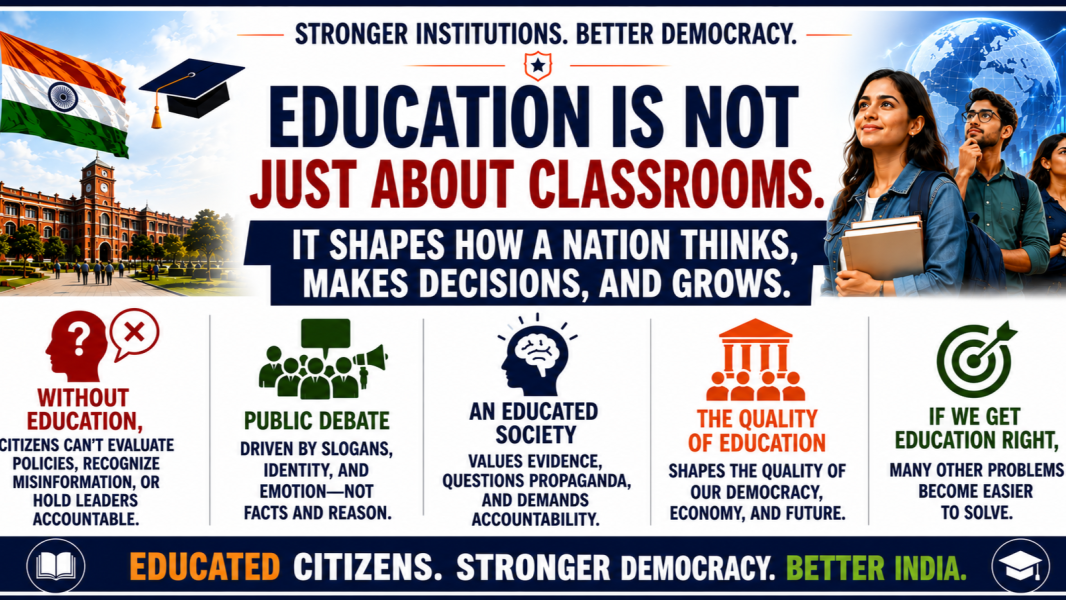
Every nation invests in roads, bridges, airports, and power plants because they are essential for economic growth. Yet the single most important investment any country can make is in its education system.
Education builds far more than knowledge. It builds citizens.
It shapes how people think, how they solve problems, how they evaluate competing ideas, and ultimately how they choose the leaders and institutions that govern them. The quality of a nation’s education system eventually determines the quality of its democracy, economy, and society.
Unfortunately, education is often viewed too narrowly.
Success is measured by examination scores, board results, university admissions, or the number of graduates produced each year. These metrics matter, but they tell only part of the story.
The real purpose of education is much larger.
It is to prepare people not only for work, but for citizenship.
Democracy Depends on an Educated Citizenry
Democracy is often described as government by the people.
But democracy can only function well when citizens are equipped to make informed decisions.
An educated society is better able to distinguish facts from misinformation, question unsupported claims, evaluate public policies, and hold governments accountable.
Without these abilities, public debate gradually shifts away from evidence and reason toward emotion, identity, slogans, and personality.
When citizens cannot critically evaluate competing ideas, elections become contests of popularity rather than informed choices about the future.
Strong democracies therefore require more than free elections.
They require educated citizens.
Education Creates Independent Thinkers
One of the greatest strengths of education is that it teaches people how to think rather than what to think.
Students should learn to ask questions.
They should learn to evaluate evidence.
They should understand how institutions work, why laws matter, and how public policy affects everyday life.
Critical thinking allows citizens to disagree respectfully while remaining committed to solving problems together.
It replaces blind acceptance with informed judgment.
In a rapidly changing world shaped by artificial intelligence, biotechnology, climate change, and digital misinformation, these skills are becoming even more valuable than memorizing facts.
Knowledge changes.
The ability to think critically remains.
Education and Economic Prosperity
Education also determines whether countries create wealth.
Modern economies compete through productivity, innovation, and skills.
Businesses invest where they can find talented workers.
Researchers innovate where universities produce world-class graduates.
Entrepreneurs create companies where education encourages creativity and problem-solving.
Countries with strong education systems attract investment because employers have confidence in the quality of their workforce.
Countries with weak education systems often struggle to create high-value jobs regardless of how many graduates they produce.
The number of degrees awarded matters far less than the capabilities those degrees represent.
Character Matters as Much as Competence
Education should not only prepare people for employment.
It should also prepare them for responsible citizenship.
Integrity.
Respect for the rule of law.
Civic responsibility.
Teamwork.
Curiosity.
Empathy.
These qualities strengthen society just as much as technical knowledge.
When education neglects character, societies may produce highly qualified professionals who still tolerate corruption, ignore public responsibilities, or place personal interests above the common good.
Great nations require both competence and character.
India’s Opportunity
India possesses one of the youngest populations in the world.
This demographic advantage could become one of the country’s greatest strengths.
But only if young people receive an education that prepares them for the future.
That requires moving beyond an education system focused primarily on examinations and rote learning.
Schools should develop critical thinking, communication, creativity, scientific reasoning, digital literacy, and practical problem-solving.
Universities should work closely with industry so graduates possess the skills employers actually need.
Teachers should be respected, well-trained, and supported with modern teaching methods.
Technology should enhance learning rather than simply digitize outdated methods.
Most importantly, education policy should remain focused on long-term national development rather than short-term political priorities.
Education Shapes Every Other Institution
Education does not operate in isolation.
It influences every major institution within society.
Well-educated citizens demand better governance.
Better governance strengthens the judiciary.
An efficient judiciary attracts investment.
Investment creates productive businesses.
Businesses generate quality jobs.
Higher incomes improve public health, reduce poverty, and expand opportunities for future generations.
Education is therefore not merely another government department.
It is the foundation upon which every other institution depends.
If the foundation is weak, every institution built upon it becomes weaker.
If the foundation is strong, the entire nation becomes stronger.
Building the India We Deserve
If India wants to become a prosperous, innovative, and developed nation, improving education must become one of its highest national priorities.
This means investing not only in school buildings but also in teacher quality, modern curricula, research universities, vocational education, and transparent systems that reward excellence and accountability.
Education should help every child develop the knowledge, skills, values, and confidence needed to build a meaningful life.
It should prepare citizens who think independently, participate responsibly in democracy, and contribute productively to society.
The countries that succeed in the twenty-first century will not necessarily be those with the largest populations or the greatest natural resources.
They will be the ones that educate their people best.
Education builds far more than careers.
It builds institutions.
It builds prosperity.
It builds democracy.
And ultimately, it builds the future of the nation itself.
Leave a Reply