
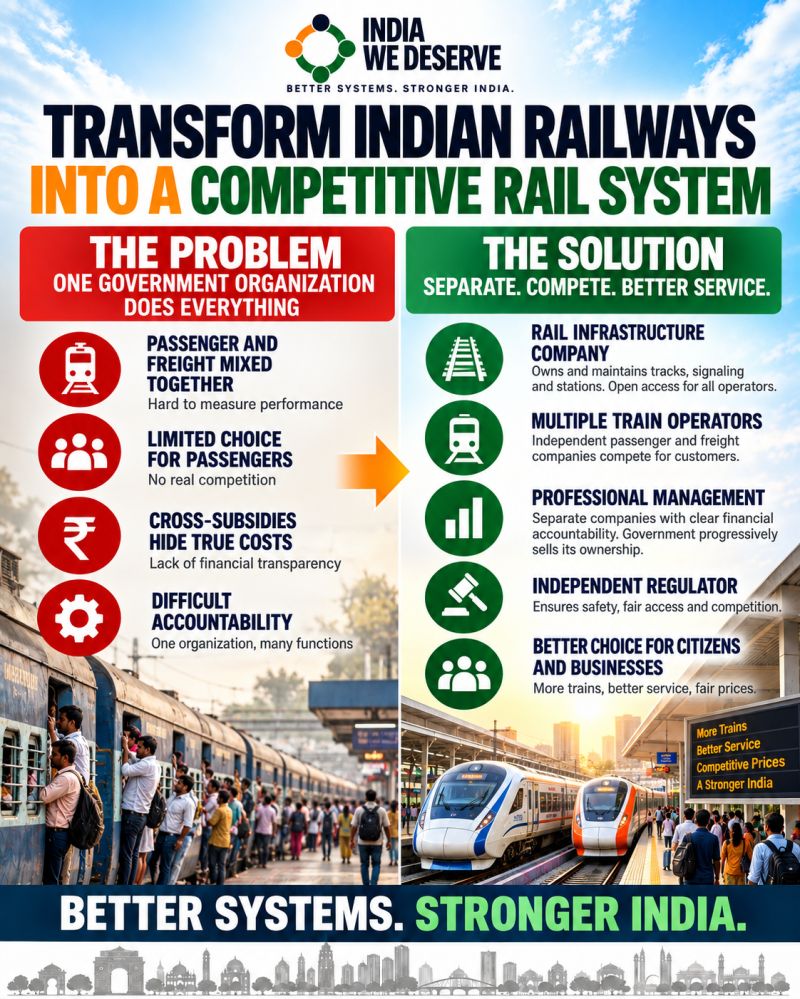
Indian Railways is one of modern India’s great achievements. Its trains connect villages to cities, workers to jobs, farmers to markets, and businesses to customers. For millions of Indians, the railway is not simply a means of transportation. It is an essential part of everyday life.
Over generations, India has built one of the world’s largest railway networks. It has connected distant regions, supported industrial development, and made long-distance travel affordable to people who might otherwise have had few alternatives.
Yet the very scale of Indian Railways raises a question we rarely ask.
Does the government need to run the trains, or should its primary responsibility be to own the infrastructure, set the rules, and ensure railway services run efficiently?
Today, Indian Railways handles almost everything. It manages tracks, signaling systems, stations, passenger trains, freight services, maintenance, scheduling, and much of the investment required to keep the system running.
These are very different businesses, requiring different skills, management approaches, and investment decisions. Yet they operate largely within one enormous government organization.
Imagine if the government not only owned and managed airports and air traffic infrastructure but also operated virtually every airline, decided which flights would run, managed ticket prices, maintained the aircraft, and determined how much freight each airline could carry.
We would naturally ask whether all those responsibilities needed to belong to the same organization.
In aviation, airlines compete to attract passengers while operating within a common framework of airports, air traffic management, and safety regulation. Competition encourages airlines to improve their services, manage costs, and respond to customers.
Railways are not identical to airlines. Railway tracks have limited capacity, trains cannot overtake one another as easily as aircraft, and scheduling requires far greater coordination. Nevertheless, the underlying question remains relevant.
Why should the organization that maintains railway infrastructure also operate every train that uses it?
When One Organization Does Everything
The problem with combining so many responsibilities is not necessarily that government employees cannot manage them effectively. Indian Railways has enormous technical expertise and has delivered significant improvements over the years.
The difficulty is understanding who is responsible for what, what each activity actually costs, and whether a different way of organizing the system could produce better results.
Consider a passenger train that regularly arrives late. Is the problem the train operator, poor maintenance, track congestion, signaling failures, or an unrealistic timetable?
When all these functions fall under the same organization, accountability becomes hard to separate.
The same challenge arises with costs.
Passenger transportation serves an important social purpose, and affordable fares are essential for millions of Indians. But when passenger services require financial support, the true cost should be visible. If freight revenues subsidize passenger fares, policymakers should know how much support is provided and what it does to freight competitiveness.
Without clear financial separation, it becomes difficult to determine whether a service is inefficient, socially necessary, or simply carrying costs that belong elsewhere.
This matters because railways are not just a public service. They are also economic infrastructure. Every unnecessary cost in moving goods eventually affects businesses, consumers, and India’s competitiveness.
A manufacturing company deciding whether to move goods by road or rail needs predictable prices, reliable delivery schedules, and responsive service. A passenger deciding whether to travel by train, bus, or air has similar expectations.
The railway system should be organized to meet those needs, rather than expecting customers to adapt to the limitations of its organizational structure.
A Different Way to Organize the Railways
India could keep its railway corridors, land, and rights-of-way as permanent national assets while separating infrastructure management from train operations.
A dedicated railway infrastructure organization would maintain tracks, manage signaling, allocate network capacity, coordinate train movements, and plan infrastructure improvements.
Professionally managed companies could then operate passenger and freight services, including public-sector enterprises, private operators, and joint ventures.
These companies would pay transparent charges to use the railway network and operate under common safety, service, and access rules.
The government would continue to protect the railway system as a national asset. It would determine safety standards, regulate access, support essential services, and invest in infrastructure that serves the country’s long-term interests.
But it would no longer need to manage every aspect of passenger and freight transport.
This distinction matters because public ownership of infrastructure does not require a government monopoly over transportation services.
India could continue to own the tracks while allowing different companies to operate trains on them.
The benefits would come not simply from introducing private companies, but from creating clearer responsibilities and incentives.
An infrastructure manager would be judged on the railway network’s safety, condition, reliability, and capacity. A passenger operator would be judged by punctuality, comfort, cleanliness, customer satisfaction, and operating efficiency. A freight operator would be judged by its ability to move goods reliably and competitively.
Instead of one organization handling everything, each would have a clearly defined purpose.
What Competition Could Mean for Passengers
Imagine traveling between Delhi and Mumbai with a choice of railway operators.
One company might offer a lower fare with basic services. Another might provide greater comfort, better onboard facilities, or more flexible booking options. A third might specialize in business travelers or overnight services.
Passengers could choose according to their preferences, much as they do when booking flights.
Competition could encourage operators to improve cleanliness, punctuality, customer service, and the overall travel experience.
However, railways require more careful coordination than airlines. There may not be enough track capacity to accommodate several companies running competing trains on every route.
On busy corridors, competition between operators may be possible. On other routes, a better approach could be to invite companies to compete for the right to provide a specified service for a fixed period.
The government could define the fares, frequency, service quality, and accessibility requirements, then award the contract through a transparent process.
The objective would be the same in either case: to make railway operators accountable for delivering reliable services at reasonable costs.
This approach would also give public-sector railway companies opportunities to demonstrate their own efficiency. Competition need not mean that private operators automatically replace government operators. Public companies should be able to compete wherever they can deliver good service.
What matters is performance, not ownership alone.
Freight May Offer an Even Greater Opportunity
Passenger trains receive most of the public attention, but freight transportation is equally important to India’s economy.
Factories need raw materials. Farmers need access to markets. Ports need reliable connections to industrial centers. Businesses need goods delivered on time.
Railways can move large volumes of freight efficiently, particularly over long distances. Yet businesses often choose road transportation because it may offer greater flexibility, more predictable delivery, or simpler logistics.
A more competitive railway freight system could change that calculation.
Imagine a manufacturer choosing among several freight operators, each offering different prices, delivery commitments, and logistics services.
Companies would have incentives to improve scheduling, cut unnecessary delays, invest in better equipment, and develop customer-tailored services.
More efficient rail freight could lower logistics costs, improve industrial competitiveness, and shift suitable freight off congested highways.
But these benefits would depend on infrastructure capacity and fair access. If one operator received preferential treatment, or if the network remained too congested to support reliable services, competition alone would accomplish little.
That is why infrastructure management and independent regulation would be central to the reform.
What Japan and Europe Can Teach Us
India would not be the first country to reconsider how to organize a national railway.
Japan faced a major railway restructuring challenge in the 1980s. Its government-owned Japanese National Railways had accumulated substantial financial and operational difficulties.
In 1987, Japan reorganized the national railway into regional passenger companies and a freight company. Several passenger companies were subsequently privatized.
The restructuring created more focused organizations with clearer financial and operational responsibilities.
Japan did not adopt exactly the model being proposed here. Many of its passenger railway companies continue to manage both their tracks and train operations. Nevertheless, its experience demonstrates that even a very large national railway can be reorganized into more focused enterprises.
Europe offers another perspective.
Several European countries have separated railway infrastructure management from train operations and developed systems allowing different operators to use shared railway networks.
These reforms have introduced competition in parts of the passenger and freight markets, although the extent and results vary considerably between countries.
They have also exposed the difficulties of managing shared infrastructure. Train scheduling, network congestion, access charges, and coordination between operators require careful regulation.
The lesson for India is not to copy one international model wholesale.
Railway infrastructure and services can be organized in different ways, and the structure should be chosen based on the outcomes it delivers.
India can learn from both Japanese restructuring and European infrastructure-access arrangements while designing a model suited to its own geography, population, traffic density, and social responsibilities.
What About Affordable Travel?
One of the strongest arguments for government involvement in railways is the need to provide affordable transportation.
That concern is legitimate.
Millions of Indians depend on trains precisely because they are more affordable than many alternatives. Some routes serve communities where commercial demand may never be sufficient to cover the full cost of operation.
A restructured railway system must protect these services.
But providing affordable transportation does not necessarily require the government to operate every train itself.
The government could define essential passenger services and pay operators under transparent contracts.
For example, if a route is socially necessary but commercially unprofitable, the government could specify the required frequency, fare structure, and service standards. Qualified operators could then compete to provide that service at the lowest reasonable public cost.
The subsidy would become visible rather than being buried within the finances of a much larger railway organization.
Citizens would continue receiving affordable transportation, while taxpayers and policymakers could see what it costs.
The government would remain responsible for ensuring access. It would simply have more than one way to deliver it.
Safety Cannot Be Left to Competition Alone
Railway safety is fundamentally different from many ordinary commercial services.
An operator cannot reduce maintenance, compromise staff training, or ignore safety procedures to offer a cheaper ticket.
Any restructuring must therefore be accompanied by strong and independent safety oversight.
Every operator, whether publicly or privately owned, would need to satisfy the same rigorous standards.
The infrastructure manager would have responsibility for the condition and safety of tracks, signaling, and other shared systems. Operators would be responsible for their trains, employees, and operating procedures.
Responsibilities would need to be clearly defined, particularly where an incident involves both infrastructure and train operations.
An independent regulator would also be necessary to ensure fair infrastructure access and prevent any operator from receiving preferential treatment.
Without effective regulation, replacing a government monopoly with a poorly regulated private market could simply create different problems.
Competition should determine who provides better services. It should never determine how safe citizens are.
Reform Without Disrupting the Network
India should not attempt such a transformation overnight.
Indian Railways is too important to the country’s economy and daily life to risk unnecessary operational disruption.
A sensible starting point would be to establish transparent financial accounts for infrastructure, passenger operations, freight services, and public-service obligations.
This alone would improve understanding of costs and performance.
The next step would be to strengthen independent regulation and establish clear rules for infrastructure access, scheduling, safety, and dispute resolution.
India could then use selected passenger and freight corridors to test different operating models.
India could compare existing services with new operators, assess whether competition improves punctuality and customer satisfaction, and determine whether coordination costs outweigh the benefits.
Successful models could be expanded gradually. Models that fail to deliver better outcomes should be revised or discontinued.
Railway employees’ interests would also need careful consideration. Their technical knowledge is an important national asset, and restructuring should include credible plans for workforce transitions, training, employment protections, and continuity of essential operations.
Reform should improve the railway system, not disrupt the people who keep it running.
Government’s Role Should Become More Important, Not Less
Many assume that allowing private participation reduces the government’s role.
In reality, a competitive railway system would require the government to become more effective at the responsibilities that only government can perform.
It would need to protect railway corridors from encroachment, plan long-term network expansion, coordinate national transportation priorities, regulate safety, ensure fair competition, and preserve essential passenger connectivity.
It would need to invest in infrastructure that commercial operators might not finance on their own.
It would also need to hold every operator accountable for measurable results.
These responsibilities are substantial. They are also different from deciding how an individual train should be staffed, maintained, priced, or marketed.
A government that focuses on setting and enforcing rules may ultimately serve citizens more effectively than one that tries to manage every commercial and operational decision.
The question should not be whether government or private companies are inherently better at running trains.
The question should be which institutional arrangement delivers safer, more reliable, more affordable, and more efficient transportation.
The India We Deserve
Indian Railways has helped build modern India. Its importance will only increase as the country urbanizes, industrializes, and seeks more efficient ways to move people and goods.
Preserving its national role does not mean preserving every aspect of its existing organizational structure.
India should examine whether separating infrastructure management from train operations, introducing carefully regulated competition, and making costs and responsibilities transparent could produce better outcomes.
Some services may remain best operated by public enterprises. Others may benefit from private participation. Some routes may support competition between operators, while others may require competitively awarded service contracts.
There is no reason to assume that one model must apply everywhere.
What matters is designing the system around the needs of passengers, businesses, and taxpayers rather than the administrative convenience of a single organization.
The government should protect the railway network, establish fair rules, ensure safety, and guarantee essential connectivity. Qualified operators should be allowed to compete and provide better services.
India does not have to choose between public ownership and operational efficiency. It can retain its railway infrastructure as a national asset while exploring new ways to deliver transportation services.
The real reform is not simply about who owns or operates the trains.
It is about creating a railway system with clear responsibilities, transparent costs, measurable performance, and better service for the public.
That is the India We Deserve.
Leave a Reply