
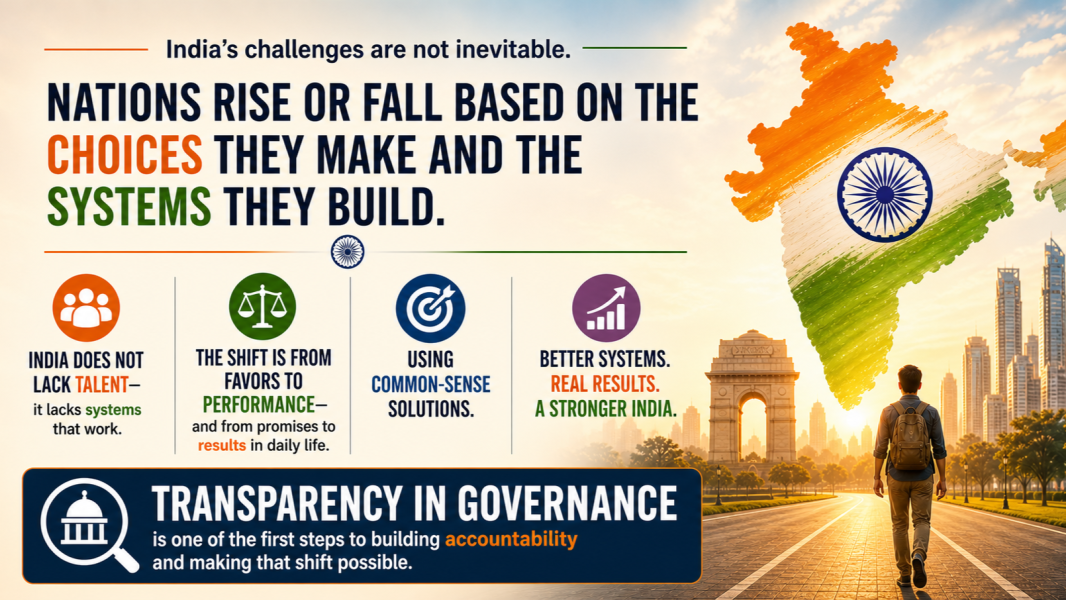
Why do some nations consistently deliver better outcomes for their citizens while others struggle despite having talented people and abundant resources?
The answer is often not talent.
It is systems.
India does not lack intelligence, ambition, or hard work. Every day, millions of Indians build businesses, educate children, care for families, innovate, create, and contribute to society. Indian professionals lead global companies. Indian entrepreneurs build successful enterprises. Indian students compete with the best in the world.
Talent is not the problem.
The challenge is that too many of the systems surrounding that talent do not work as well as they should.
When a citizen must make multiple visits to receive a government service, that is a systems problem.
When a child attends school but does not learn, that is a systems problem.
When roads are built but not maintained, when laws exist but are not enforced, when public services depend more on influence than process, the issue is not a lack of effort. It is a lack of effective systems.
The good news is that these challenges are not inevitable.
History shows that nations rise and fall based on the choices they make and the institutions they build.
Countries that deliver reliable public services, maintain accountability, enforce laws fairly, and invest in long-term systems create opportunities for ordinary citizens to succeed.
Countries that rely primarily on announcements, personalities, or short-term solutions often struggle to sustain progress.
India’s next stage of development will depend less on what we promise and more on what we consistently deliver.
The shift must be from favors to performance.
Citizens should not need personal connections to obtain services they are already entitled to receive. Systems should work the same way for everyone.
The shift must also be from promises to results.
The measure of success is not the number of policies announced. It is whether daily life improves for citizens.
Can children learn?
Can people access healthcare?
Can businesses operate efficiently?
Can citizens receive public services without unnecessary delays?
Can communities trust that rules will be applied fairly?
These are the outcomes that matter.
One of the most important foundations for achieving those outcomes is transparency.
Transparency allows citizens to see how decisions are made, how money is spent, and whether commitments are being fulfilled.
Without transparency, accountability becomes difficult.
Without accountability, performance often declines.
When information is visible, performance can be measured. When performance can be measured, institutions can improve. And when institutions improve, citizens benefit.
Building effective systems does not require revolutionary ideas.
It requires consistent execution, clear accountability, and a commitment to solving problems using practical, common-sense approaches.
India’s future will not be determined by a lack of talent.
It will be determined by whether we build systems worthy of that talent.
Because when systems work, opportunity expands.
And when opportunity expands, nations prosper.
The question is not whether India can succeed.
The question is whether we will build the systems that allow every citizen the opportunity to succeed.
Leave a Reply