
Why do millions of Indians begin and end each day breathing air that would be considered unsafe in many parts of the world?
Air pollution has become one of India’s most serious public health challenges.
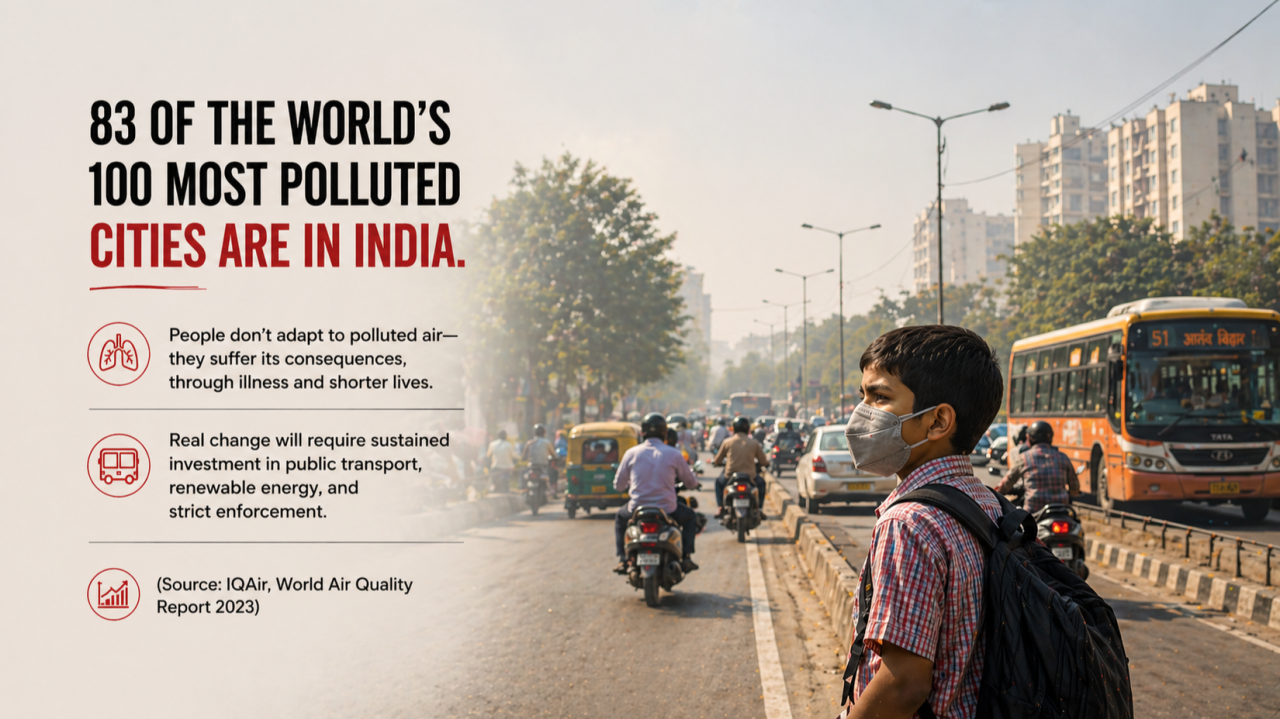
According to the IQAir World Air Quality Report 2023, India is home to 83 of the world’s 100 most polluted cities. For millions of citizens, poor air quality is not an occasional inconvenience. It is a daily reality.
And unlike many other challenges, pollution does not remain confined to a neighborhood, a city, or a social class.
The air we breathe belongs to everyone.
Children walking to school, workers commuting to their jobs, street vendors, professionals, and retirees all share the same atmosphere. When air quality deteriorates, everyone pays a price.
The cost, however, is not measured only in pollution levels.
It is measured in asthma attacks, respiratory illnesses, heart disease, missed school days, reduced productivity, and shortened lives.
For many families, the effects are deeply personal. Parents worry about their children developing breathing problems. Elderly relatives struggle with chronic health conditions. Outdoor workers spend entire days exposed to unhealthy air.
This is not simply an environmental issue.
It is a public health issue.
It is an economic issue.
And it is a quality-of-life issue.
Poor air quality places additional pressure on healthcare systems, increases medical expenses for families, and reduces workforce productivity. When millions of people are less healthy, the entire economy bears the cost.
India has made important progress in expanding access to electricity, transportation, and industrial development. These achievements have improved the lives of millions. Yet economic growth and environmental responsibility cannot be viewed as competing goals.
A modern nation requires both.
The path forward is not mysterious.
India must continue investing in cleaner public transportation, renewable energy, better urban planning, and more efficient industrial practices. Equally important, environmental regulations must be enforced consistently and transparently.
Policies alone do not clean the air.
Implementation does.
Citizens should not have to choose between economic opportunity and clean air. They deserve both.
The true measure of development is not only the roads we build, the factories we open, or the GDP we generate. It is whether people can live healthier, longer, and more productive lives.
Clean air should not be a privilege available to a few.
It should be a basic expectation for everyone.
Because the air we all breathe should not be making us sick.
Source: IQAir, World Air Quality Report 2023
Leave a Reply