
Why do so many Indian families continue to feel insecure despite decades of economic growth?
India has made remarkable progress. Millions have moved out of extreme poverty. New highways connect cities. Digital payments have transformed commerce. Startups attract global investment. The economy has become one of the largest in the world.
Yet beneath this progress lies a reality that receives far less attention.
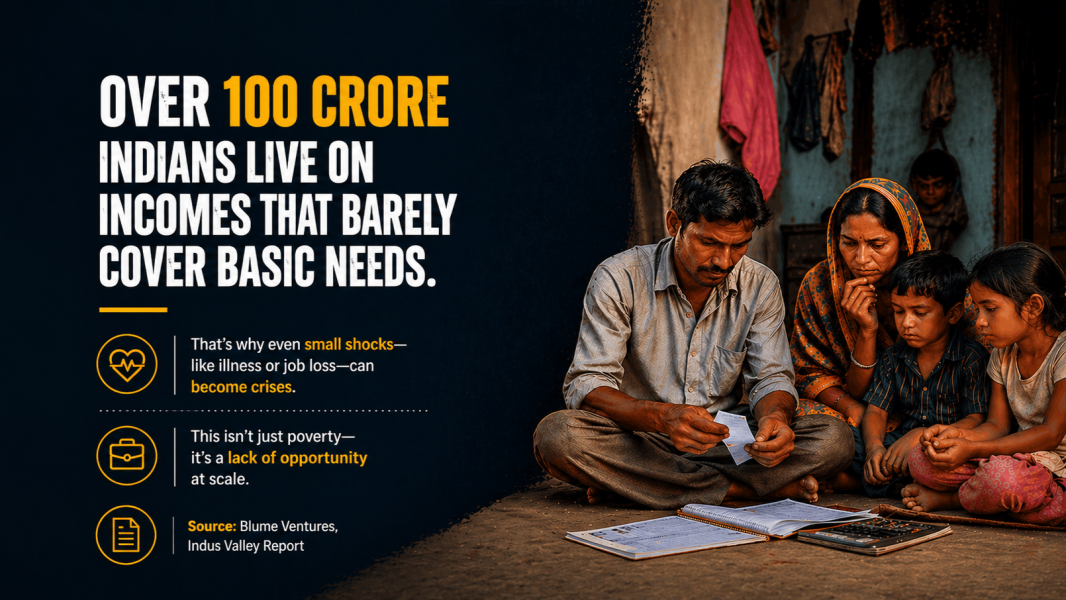
According to the Indus Valley Report published by Blume Ventures, over 100 crore Indians live with little room beyond the basics. Their incomes are sufficient to cover daily necessities, but often not enough to build meaningful savings or financial security.
For these families, life can remain stable for months or even years. But stability is fragile.
A medical emergency. A lost job. A failed crop. A business slowdown. An unexpected expense.
Any one of these events can push a family into financial distress.
This is not simply a story about poverty. It is a story about vulnerability.
The difference matters.
A family may not be poor by official definitions, yet still live one setback away from crisis. When households have no savings cushion, limited access to affordable healthcare, weak social protection, and uncertain employment, economic progress can disappear overnight.
This affects hundreds of millions of people.
The challenge is not that Indians lack ambition. Every day, millions of workers, farmers, small business owners, teachers, drivers, shopkeepers, and professionals work hard to improve their lives.
The challenge is that opportunity remains uneven.
A child born into one family may attend a quality school, receive healthcare when needed, build skills, and access professional networks. Another child, equally talented, may struggle because those systems are missing.
Talent is distributed widely. Opportunity is not.
A strong nation cannot depend solely on exceptional individuals succeeding despite obstacles. It must create systems that allow ordinary citizens to succeed because those systems work.
That means focusing on the foundations of opportunity:
- Reliable public education.
- Affordable healthcare.
- Safe and efficient transportation.
- Clean water and sanitation.
- Effective law enforcement.
- Transparent local governance.
- Jobs that provide pathways to economic mobility.
Economic growth remains essential. But growth alone is not enough.
The true measure of success is not how many people become wealthy. It is how many people can withstand life’s inevitable setbacks without falling into crisis.
A society becomes stronger when a hospital bill does not destroy a family’s savings, when a job loss does not threaten homelessness, and when every child has a fair chance to build a better future.
More than 100 crore Indians are not asking for privilege.
They are asking for an opportunity.
And building that opportunity at scale may be the most important task facing India in the decades ahead.
Source: Blume Ventures, Indus Valley Report
Leave a Reply