
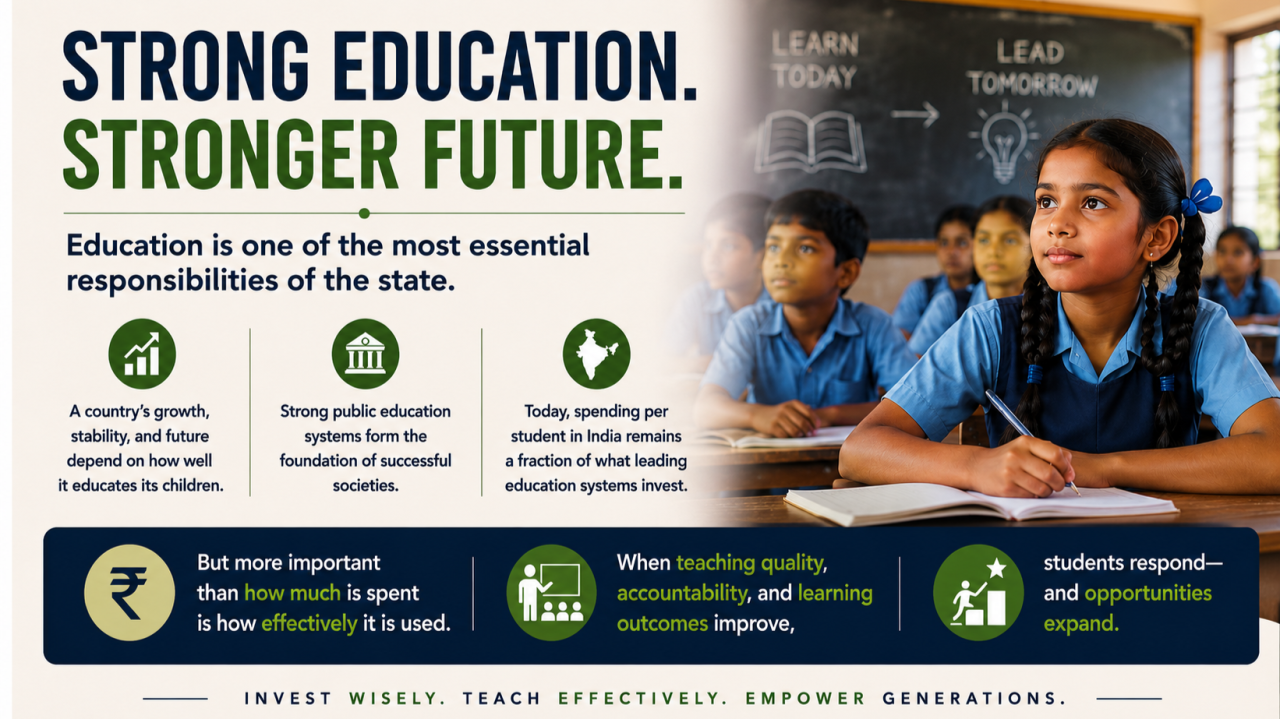
Every nation eventually becomes a reflection of its education system.
The engineers who build its infrastructure, the doctors who care for its people, the teachers who shape the next generation, the entrepreneurs who create jobs, and the public servants who run its institutions all begin in a classroom.
Education is not simply another government program. It is one of the state’s most important responsibilities.
Countries that have transformed themselves over the past few decades—from Singapore and South Korea to Finland and Ireland—did not succeed by chance. They invested consistently in educating their people and built systems that rewarded learning, accountability, and excellence.
India has made significant progress over the past several decades. Millions more children now attend school than ever before, literacy has improved, and access to education has expanded across much of the country. These achievements deserve recognition.
Yet enrollment alone is not enough.
The real measure of an education system is what students know when they leave the classroom.
Today, public spending per student in India remains only a fraction of what many leading education systems invest. While funding matters, simply allocating more money will not automatically improve outcomes.
The more important question is whether every rupee spent translates into better learning.
Children need safe classrooms, functioning toilets, reliable electricity, libraries, laboratories, and digital access. Teachers need continuous training, modern teaching methods, competitive compensation, and opportunities for professional growth. Parents deserve transparent information about how well schools are performing. Governments need reliable data to identify what works and what does not.
Above all, education systems need accountability.
Schools should not be measured only by attendance or examination results. They should be evaluated by how effectively students develop literacy, numeracy, problem-solving abilities, communication skills, and the confidence needed to succeed in life.
Good education creates opportunity.
It reduces poverty, strengthens social mobility, attracts investment, improves public health, increases productivity, and supports innovation. Every improvement made in a classroom today compounds into stronger institutions and a more prosperous society tomorrow.
India does not need to copy another country’s education system. It must build one that reflects its own strengths, diversity, and aspirations while remaining focused on measurable outcomes and continuous improvement.
Education reform should not be viewed as an expense.
It is one of the highest-return investments any nation can make.
If India wants stronger institutions, better governance, higher productivity, and greater opportunity over the coming decades, it must continue to strengthen its education system—not only by investing more, but also by ensuring every investment produces better learning for every child.
A stronger India begins with better education.
Leave a Reply