
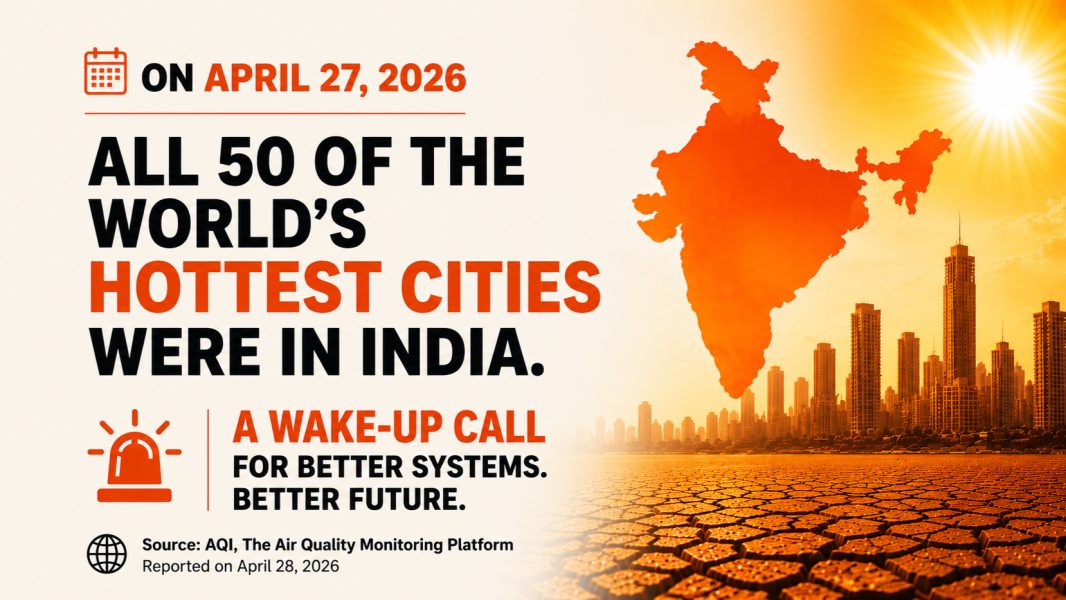
On April 27, 2026, reports indicated that all 50 of the world’s hottest cities were in India. Whether viewed as a single day’s extreme weather or part of a broader trend, it should serve as a wake-up call.
Extreme heat is no longer just an environmental concern. It is becoming an economic, public health, and governance challenge that affects nearly every aspect of daily life.
For millions of Indians, high temperatures are more than an inconvenience. They can mean lost wages, declining productivity, rising electricity bills, water shortages, and serious health risks. Outdoor workers—including construction workers, farmers, delivery personnel, street vendors, and sanitation workers—often have little choice but to continue working despite dangerous conditions.
The burden falls most heavily on lower- and middle-income households. Nearly one billion Indians live in households earning around ₹25,000 or less per month. Many lack reliable cooling, well-insulated housing, or easy access to healthcare. For these families, every additional degree of heat carries real economic and social consequences.
Extreme heat also places enormous pressure on public systems.
Electricity demand rises sharply as households and businesses rely more heavily on cooling. Water supplies become strained. Roads, railways, and other infrastructure face greater wear. Hospitals experience increased admissions related to heat exhaustion and dehydration. Schools may shorten schedules or close temporarily, disrupting education.
As India’s economy continues to grow and its cities become larger and denser, these challenges are likely to become more frequent.
Responding to them requires more than emergency measures during the summer. It requires long-term planning.
Cities need more trees, parks, and green spaces that reduce urban heat. Building standards should encourage designs that improve natural cooling and energy efficiency. Water conservation, rainwater harvesting, and groundwater management must become priorities rather than afterthoughts. Public transport, roads, electricity grids, and healthcare systems should be designed with greater resilience to extreme weather.
Technology also has an important role to play. Better weather forecasting, heat-warning systems, smart energy management, and data-driven urban planning can help governments prepare for extreme conditions before they become emergencies.
None of these solutions is particularly new. Many have been successfully implemented in cities around the world. The challenge is not a lack of ideas—it is the ability to plan consistently, execute effectively, and maintain public systems over the long term.
Climate resilience is not only an environmental issue. It is an investment in economic growth, public health, and quality of life.
As India builds the next generation of cities and infrastructure, resilience should become part of every major planning decision. Better systems today will reduce costs tomorrow, protect vulnerable communities, and strengthen the country’s ability to thrive despite a changing climate.
Extreme heat is reminding us that the future cannot be managed with short-term thinking alone.
Building the India we deserve means building institutions and public systems that are prepared not only for today’s challenges, but for those of the decades ahead.
Sources: AQI, The Air Quality Monitoring Platform; CNN reporting (May 2026); State of Inequality in India Report, Economic Advisory Council to the Prime Minister (2022).
Leave a Reply