
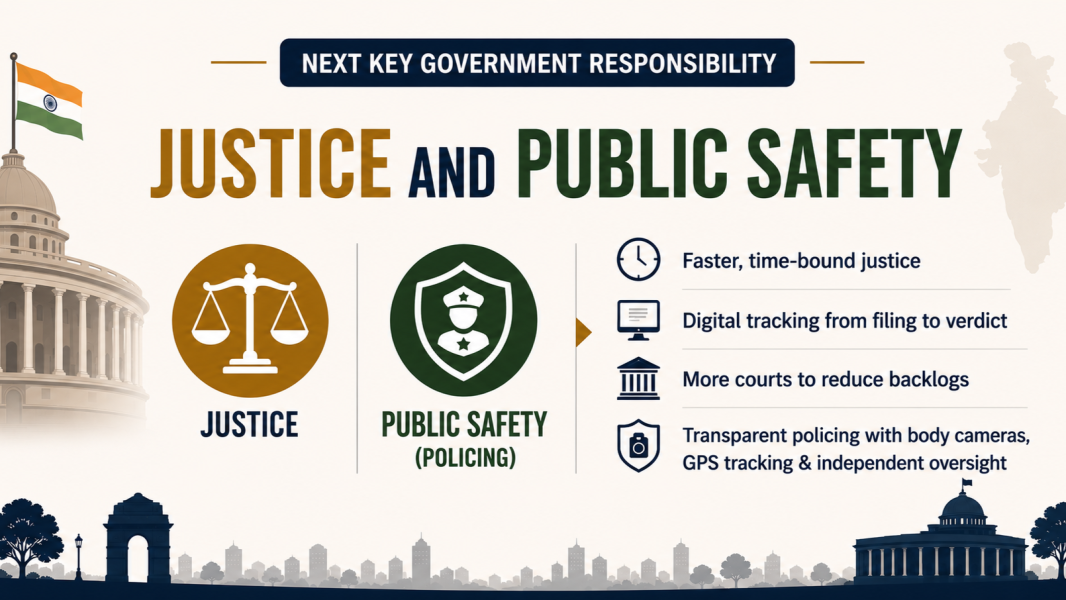
Every citizen expects certain basic guarantees from the state: the opportunity to receive a good education, the confidence that justice will be delivered fairly, and the assurance that they and their families can live in safety.
These are not optional government services. They are among the most fundamental responsibilities of any nation.
When justice is delayed or public safety is weak, the effects extend far beyond the courtroom or the police station. Businesses hesitate to invest, contracts become harder to enforce, victims lose faith in the legal system, and ordinary citizens begin to believe that influence matters more than the rule of law.
A strong economy and a strong democracy both depend on strong institutions.
India has made significant progress in many areas, but the justice system faces an enormous challenge. Today, India has only around 15–21 judges per million people, compared with more than 100 judges per million in the United States and over 50 per million in many European countries. As a result, more than 45 million cases remain pending across the country’s courts.
For millions of people, justice delayed often becomes justice denied.
The challenge extends beyond the judiciary.
India has approximately 150 police officers per 100,000 people, well below the United Nations benchmark of 222 and lower than countries such as the United States and the United Kingdom. Many police departments remain understaffed and overburdened, leaving officers with little time for proactive policing and community engagement.
The goal of policing should not simply be to respond after a crime has occurred. It should also be to prevent crime, build trust within communities, and ensure that citizens feel safe in their daily lives.
Fortunately, these challenges are not insurmountable.
Many improvements can be achieved through practical institutional reforms rather than dramatic structural changes.
Courts can adopt time-bound case management systems that reduce unnecessary delays and ensure cases move through the system more efficiently. Digital platforms can allow citizens to track cases from filing to final judgment, increasing transparency while reducing administrative burdens. Expanding court capacity through additional judges, modern courtrooms, and improved support staff can gradually reduce the backlog of pending cases.
Similarly, policing can benefit from greater use of technology and accountability. Body-worn cameras, GPS-tracked patrol vehicles, electronic FIR systems, digital evidence management, and independent oversight can improve transparency while strengthening public confidence in law enforcement.
Technology should not replace human judgment. It should help institutions become more efficient, more transparent, and more accountable.
Ultimately, justice and public safety are about trust.
Citizens are more likely to respect the law when they believe it is applied fairly. Businesses are more willing to invest when contracts can be enforced. Communities become stronger when people feel safe walking their streets and confident that public institutions will protect their rights.
Building stronger institutions is not simply about improving government performance. It is about creating a society where fairness, accountability, and opportunity become everyday realities.
Justice delivered on time and public safety built on trust are not aspirations. They are essential foundations of the India we deserve.
Leave a Reply