
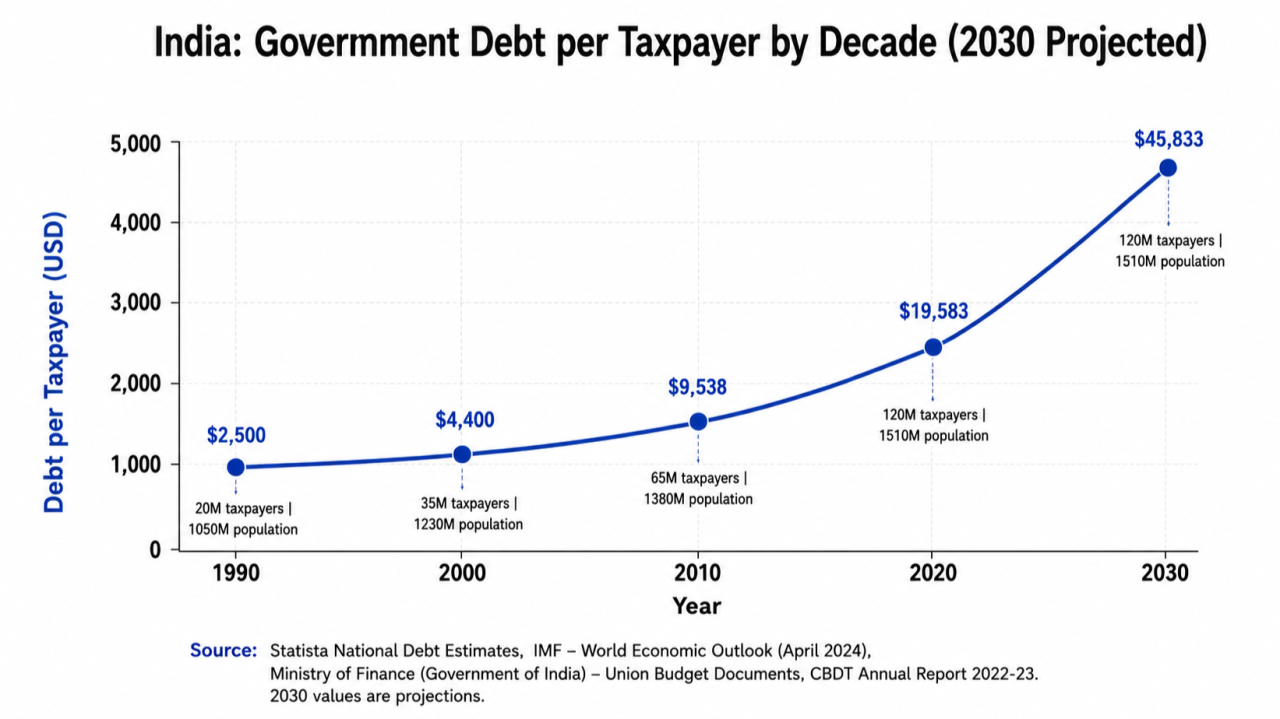
India’s public debt is rising steadily. While borrowing has helped finance infrastructure, welfare programs, and economic development, it also raises an important question that every country must eventually answer:
Who will repay today’s debt?
Every newborn taxpayer in India inherits a larger share of government debt than their generation before them. In 1990, government debt per taxpayer was estimated at roughly $2,500. If current trends continue, that figure could exceed $45,000 by 2030.
The number itself is not the central concern. What matters is whether today’s borrowing creates enough long-term value to support tomorrow’s obligations.
Debt is neither good nor bad. Its impact depends entirely on how it is used.
Countries such as the United States, Japan, and South Korea borrowed heavily during periods of rapid development. But much of that borrowing financed highways, ports, research universities, scientific innovation, healthcare, and education. These investments increased productivity, created new industries, and generated the economic growth needed to service the debt.
Borrowing became an investment rather than an expense.
India now faces a similar choice.
The country has made extraordinary progress over the past three decades. It has become one of the world’s fastest-growing major economies, built world-class digital public infrastructure, expanded highways and railways, and lifted millions of people out of poverty. These achievements deserve recognition.
Yet sustaining that progress over the next thirty years will require more than continued government spending.
Long-term prosperity depends on the strength of the institutions that support economic growth. A modern economy cannot rely indefinitely on borrowing, consumption, and public expenditure. At some point, growth must increasingly come from higher productivity, innovation, entrepreneurship, and efficient institutions.
That transition becomes difficult without strong public education, an efficient judicial system, accountable governance, empowered local governments, reliable infrastructure, vibrant research ecosystems, and globally competitive private enterprise.
These institutions are not separate from economic growth—they are what make sustained growth possible.
Education produces a skilled workforce capable of creating new industries. Efficient courts encourage investment by protecting contracts and resolving disputes quickly. Transparent governance improves public confidence and ensures that public money is spent effectively. Innovation ecosystems help businesses develop products that compete in global markets rather than relying solely on low-cost labor.
When these systems become stronger, the economy generates more value from every rupee invested.
When they remain weak, governments often compensate by raising spending and borrowing more, creating a cycle that becomes increasingly difficult to sustain.
India’s demographic advantage makes this challenge even more important. The country has one of the world’s youngest populations, providing a tremendous opportunity to build a highly productive economy. But a young population becomes an economic dividend only when people receive quality education, develop relevant skills, and have access to productive employment.
Otherwise, the burden of servicing growing public debt falls on a workforce that may not earn enough to support it.
Fiscal responsibility is therefore about much more than reducing deficits. It is about ensuring that borrowed money builds assets that continue generating economic value long after the money has been spent.
Every highway should improve productivity. Every school should improve learning. Every court reform should improve the business environment. Every public investment should strengthen India’s long-term competitiveness.
Borrowing to finance consumption creates temporary growth. Borrowing to build productive institutions creates lasting prosperity.
India has already shown that it can grow rapidly. The next challenge is determining whether that growth can be sustained for generations.
The question is no longer whether India can become a larger economy.
The question is whether India can build institutions strong enough to ensure that future generations inherit opportunity—not simply a larger debt burden.
Leave a Reply