
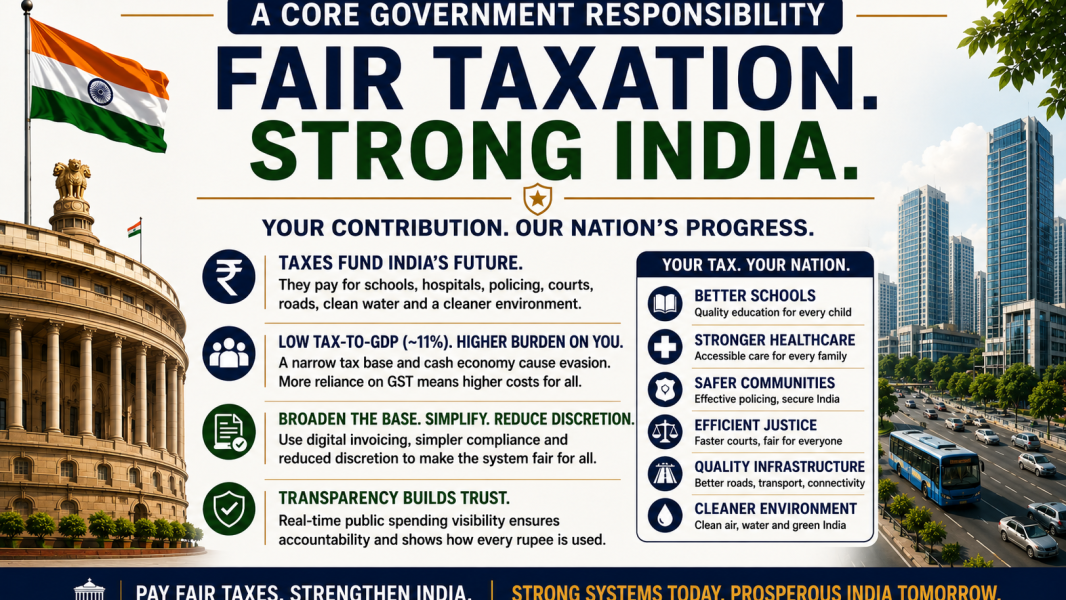
Taxes are often viewed as a financial burden. In reality, they are one of the foundations of a functioning society. Every school, hospital, courtroom, police station, highway, water system, and public service depends on governments having the resources to provide them.
The issue is not whether citizens should pay taxes. The real question is whether the tax system is fair, efficient, and trusted.
India’s tax-to-GDP ratio is approximately 11%, among the lowest for major economies. While the economy has expanded rapidly over the past three decades, the country’s tax base remains relatively narrow. A small proportion of individuals and businesses contribute a large share of direct taxes, while significant economic activity continues to operate outside the formal tax system.
This creates two challenges.
First, governments collect less revenue than they need to invest adequately in education, healthcare, public safety, infrastructure, and environmental protection.
Second, the burden shifts toward indirect taxes such as the Goods and Services Tax (GST). Unlike income taxes, indirect taxes are paid by everyone regardless of income. Whether a person is wealthy or struggling financially, they often pay the same tax rate when purchasing goods and services. As a result, greater reliance on indirect taxation can place a disproportionate burden on lower- and middle-income households.
The solution is not simply to raise tax rates.
Instead, India should broaden its tax base by making compliance simpler, more transparent, and more predictable. Digital invoicing, electronic payments, better data integration, and simpler tax procedures can encourage more businesses to participate in the formal economy while reducing opportunities for tax evasion.
Equally important is reducing unnecessary complexity. When tax rules become easier to understand and compliance becomes less burdensome, voluntary compliance tends to improve. Businesses can spend more time creating value and less time navigating administrative procedures.
But taxation is only one side of the equation.
Citizens are more willing to pay taxes when they trust that public money is being used responsibly. Trust grows when governments demonstrate transparency, publish measurable outcomes, and show how tax revenue is improving public services.
Technology now makes this possible.
Governments can publish real-time dashboards showing where public money is being spent, the progress of infrastructure projects, school performance, healthcare investments, environmental initiatives, and other measurable outcomes. Greater transparency allows citizens to see how their taxes are being used and strengthens accountability across every level of government.
A modern tax system should therefore pursue two objectives simultaneously: collect revenue fairly and spend it transparently.
When more citizens participate in the tax system, governments become less dependent on indirect taxation. When public spending becomes more visible, confidence in government increases. Together, these reforms create a virtuous cycle of higher compliance, better public services, and stronger institutions.
Taxes should not be viewed merely as money collected by the government.
They are an investment citizens make in the shared infrastructure, institutions, and opportunities that support national prosperity.
A strong nation requires citizens who contribute fairly—and governments that spend responsibly, transparently, and accountably.
Leave a Reply