
Modern governments oversee some of the most complex systems in society. Managing a national economy, building digital infrastructure, responding to public health crises, reforming education, developing infrastructure, or protecting the environment requires deep technical knowledge and years of experience. Yet in India, the individuals responsible for leading these ministries are almost always elected politicians, regardless of whether they possess expertise in the subject.
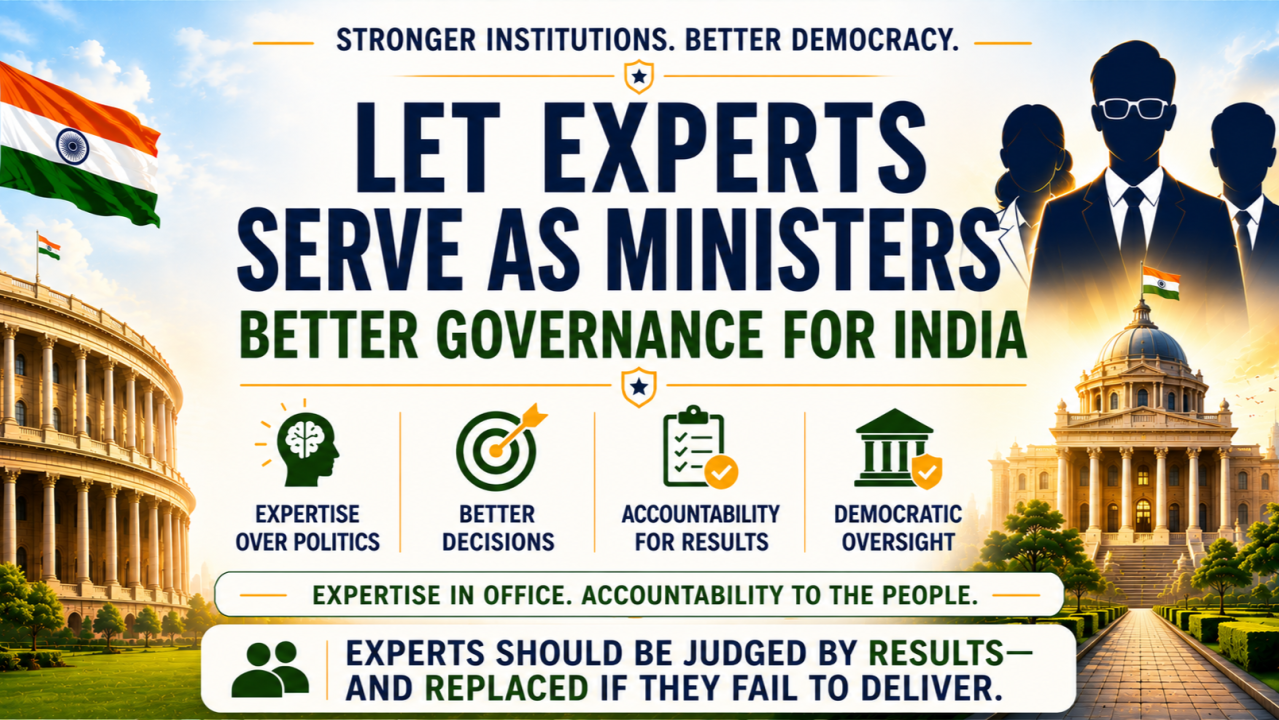
India should consider allowing experts to serve as Ministers without requiring them to be elected politicians. This would not weaken democracy. On the contrary, it could strengthen governance by ensuring that some of the country’s most important decisions are guided by knowledge, experience, and measurable results.
Governance today is far more specialized than it was a few decades ago. Artificial intelligence, cybersecurity, financial regulation, biotechnology, climate resilience, water management, urban planning, and energy policy are all highly technical fields. Expecting every elected leader to possess deep expertise across these areas is unrealistic. Just as hospitals are led by doctors and major engineering projects by engineers, ministries responsible for complex sectors should benefit from leaders who have spent their careers developing expertise in those fields.
Many successful democracies already recognize the value of combining political leadership with professional expertise. Countries such as Singapore and South Korea have frequently appointed experienced professionals, academics, economists, and technologists to senior ministerial positions. In the United States, Cabinet Secretaries are nominated by the President and confirmed by the Senate, with many selected because of their expertise rather than electoral experience. In each of these systems, democratic accountability remains intact because elected representatives continue to set national priorities, approve appointments, allocate budgets, and oversee performance.
India can adopt a similar approach while preserving its own democratic traditions. Elected representatives should continue to represent citizens, make laws, and determine the country’s priorities. Experts, meanwhile, can focus on designing policy, managing implementation, improving administrative efficiency, and delivering measurable outcomes. Politics and expertise are not competing ideas—they are complementary. Political leadership provides direction, while expert leadership improves execution.
Such appointments should be made through a transparent process based on qualifications, experience, integrity, and a proven record of achievement rather than political loyalty alone. More importantly, experts should be judged by results. Have students learned more? Has healthcare improved? Has infrastructure been delivered on time and within budget? Has the ministry become more efficient? If the answer is no, they should be replaced. Public office should be based on performance, not permanence.
As India grows into one of the world’s largest economies, governing the country will only become more complex. Strengthening institutions requires ensuring that key ministries are led by individuals with the knowledge and experience needed to make informed decisions and execute them effectively. Allowing experts to lead ministries such as Finance, Technology, Health, Education, Infrastructure, and Environment would not reduce the role of elected leaders. It would give those leaders access to the best expertise available while remaining fully accountable to Parliament and the people.
India’s future will depend not only on electing capable leaders but also on building institutions that consistently deliver results. A modern democracy should value both democratic legitimacy and professional competence. The two are not alternatives—they are partners in good governance.
Leave a Reply