
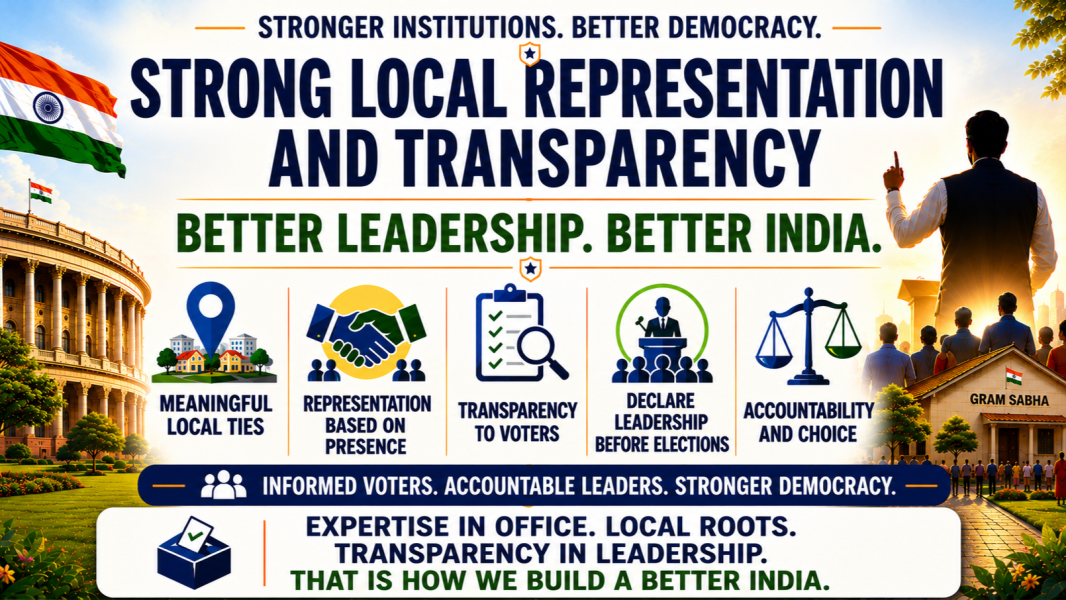
Political representation is one of the cornerstones of a healthy democracy. Citizens elect representatives not only to make laws but also to understand the aspirations, concerns, and everyday realities of the communities they serve. For democracy to function effectively, voters must feel that their elected representatives genuinely know the people, understand local challenges, and remain accountable throughout their term—not just during election campaigns.
One important reform is to strengthen the connection between elected representatives and the constituencies they seek to represent. Today, political parties sometimes nominate candidates in districts where they have little or no long-term connection. Such decisions may make political sense, but they can weaken local representation. A constituency is more than a collection of voters; it is a community with its own history, culture, economy, and priorities.
India should consider requiring candidates to have meaningful ties to the constituencies they wish to represent, including having lived there for a substantial period. This does not guarantee good leadership, but it increases the likelihood that representatives have firsthand knowledge of local issues and have built relationships with the people they hope to serve.
A representative who has lived in a community is more likely to understand the condition of its schools, hospitals, roads, public transport, water supply, sanitation, law and order, and employment opportunities. They are more likely to have experienced the same public services as the people they represent and therefore have a stronger incentive to improve them. Representation should be based on presence and understanding—not simply on fulfilling legal paperwork or being strategically placed by a political party.
Local representation also encourages greater accountability. Representatives who continue to live in or remain closely connected to their constituency are more accessible to citizens and are more likely to hear concerns directly rather than relying solely on reports from party workers or government officials. Strong local connections help build trust between citizens and their elected leaders.
Another important reform is to improve transparency in political leadership before elections. While voters elect local candidates, they are also choosing the leadership that will govern the country or the state. Yet political parties do not always clearly identify their Prime Ministerial or Chief Ministerial candidate before an election. In some cases, this decision is made only after the results are announced.
Voters deserve greater clarity. Political parties should publicly declare their Prime Ministerial or Chief Ministerial candidate before elections, along with the key members of the leadership team expected to oversee major ministries, including Finance, Home Affairs, Education, Health, Infrastructure, Agriculture, and Foreign Affairs. Elections should not only be about party symbols and campaign slogans; they should also allow citizens to evaluate the individuals who are likely to make the country’s most important decisions.
Declaring leadership teams in advance would improve transparency and accountability. Citizens would have the opportunity to assess the qualifications, experience, integrity, and vision of those seeking to govern. Political parties would also be encouraged to develop stronger leadership pipelines rather than relying on uncertainty or last-minute decisions.
Such transparency would make election campaigns more substantive. Public debate could focus more on leadership, competence, policy priorities, and the ability to govern, rather than speculation about who may ultimately hold key positions after the election. It would also enable voters to compare not only competing manifestos but also the teams responsible for implementing them.
These reforms would not change the fundamental principles of parliamentary democracy or reduce the role of elected representatives. Instead, they would strengthen democratic accountability by ensuring that citizens know both who is asking for their vote and who is likely to lead the government if that party is elected.
India’s democracy has grown remarkably over the past seven decades. As the country continues to evolve, democratic institutions must also evolve to meet higher expectations of transparency, accountability, and effective governance. Stronger local representation and greater openness about political leadership are practical reforms that can deepen public trust and improve the quality of governance.
A strong democracy is built not only on free and fair elections but also on informed choices. When representatives have genuine roots in the communities they serve, and when voters know who will lead the government before they cast their ballot, democracy becomes more transparent, more accountable, and ultimately more responsive to the people it exists to serve.
Leave a Reply