
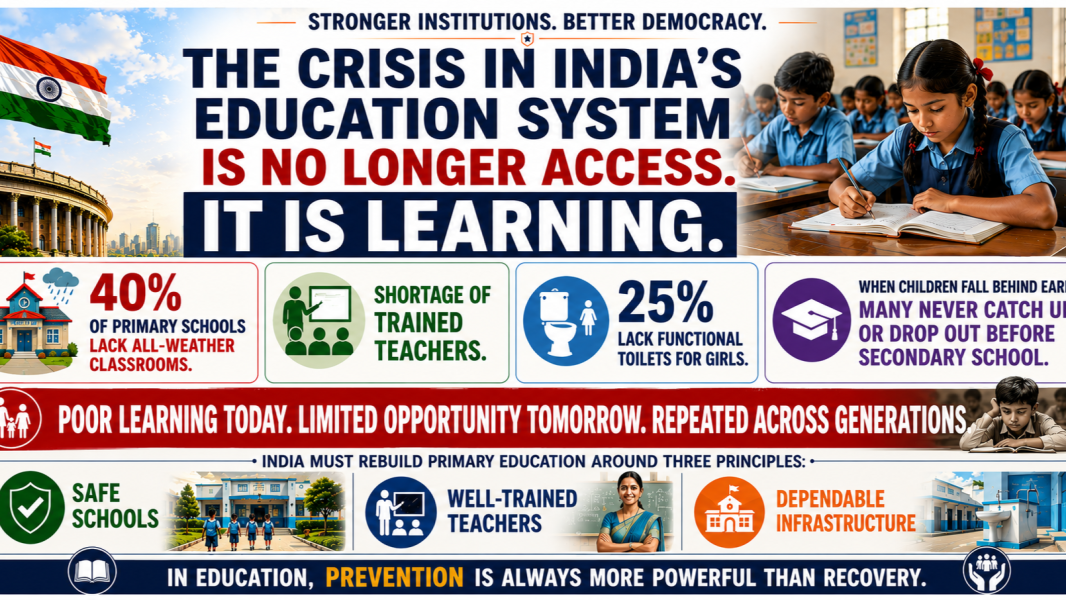
Over the past several decades, India has made remarkable progress in expanding access to education. Millions more children are enrolled in school than ever before, and the country has built one of the largest school systems in the world. Access, while still imperfect in some remote areas, is no longer India’s greatest educational challenge.
The real crisis today is learning.
A child attending school is not the same as a child receiving a quality education. Across much of the country, students complete primary school without mastering basic reading, writing, and arithmetic. These learning gaps emerge early and often widen with each passing year.
The consequences extend far beyond the classroom. A child who struggles to read in the early grades is likely to struggle in every other subject that follows. Mathematics becomes more difficult, science becomes harder to understand, confidence declines, and many students eventually disengage from education altogether. Some quietly leave school before reaching secondary education, while others remain enrolled but are unable to achieve the skills needed for higher education or meaningful employment.
The roots of this problem lie in the quality of the learning environment.
Nearly 40% of India’s primary schools still lack all-weather classrooms. Many schools continue to face shortages of qualified and well-trained teachers. Around one in four schools lack functional toilets for girls, creating unnecessary barriers to attendance, dignity, and retention. In many places, inadequate infrastructure sends an unintended message that education is not a national priority.
These shortcomings affect more than academic performance. They shape opportunity throughout a person’s life.
When children receive a weak foundation in primary school, the effects often continue into adulthood. Lower educational attainment limits employment opportunities, reduces earning potential, and weakens social mobility. Families that struggle today are more likely to see the same challenges repeated in the next generation. Educational inequality becomes economic inequality, which in turn reinforces social inequality.
This is why primary education deserves far greater national attention.
The early years are when children develop literacy, numeracy, curiosity, confidence, and lifelong learning habits. Investments made during this period produce some of the highest social and economic returns of any public expenditure. Conversely, trying to compensate for poor primary education later through remedial programs, vocational training, or higher education initiatives is significantly more difficult and far more expensive.
India should rebuild primary education around three simple but essential principles.
First, every child deserves a safe, well-maintained school with reliable classrooms, electricity, clean drinking water, and functional sanitation facilities.
Second, every classroom should be led by a well-trained teacher who receives ongoing professional development, effective support, and clear accountability for student learning.
Third, dependable infrastructure should become the norm rather than the exception. Schools cannot deliver world-class outcomes if basic facilities remain inconsistent.
Improving learning outcomes will require better measurement, stronger teacher preparation, evidence-based teaching methods, and sustained investment. Success should not be measured only by enrollment or examination results, but by whether children are actually acquiring the knowledge and skills needed to succeed in life.
Education is the foundation upon which every other national aspiration depends. Economic growth, innovation, healthcare, public safety, and democratic participation all rely on an educated population.
India has already made tremendous progress in getting children into schools.
The next challenge is ensuring that every child truly learns once they are there.
In education, prevention is always more powerful than recovery. Building strong foundations during the early years is one of the most effective investments India can make in its future.
Leave a Reply