
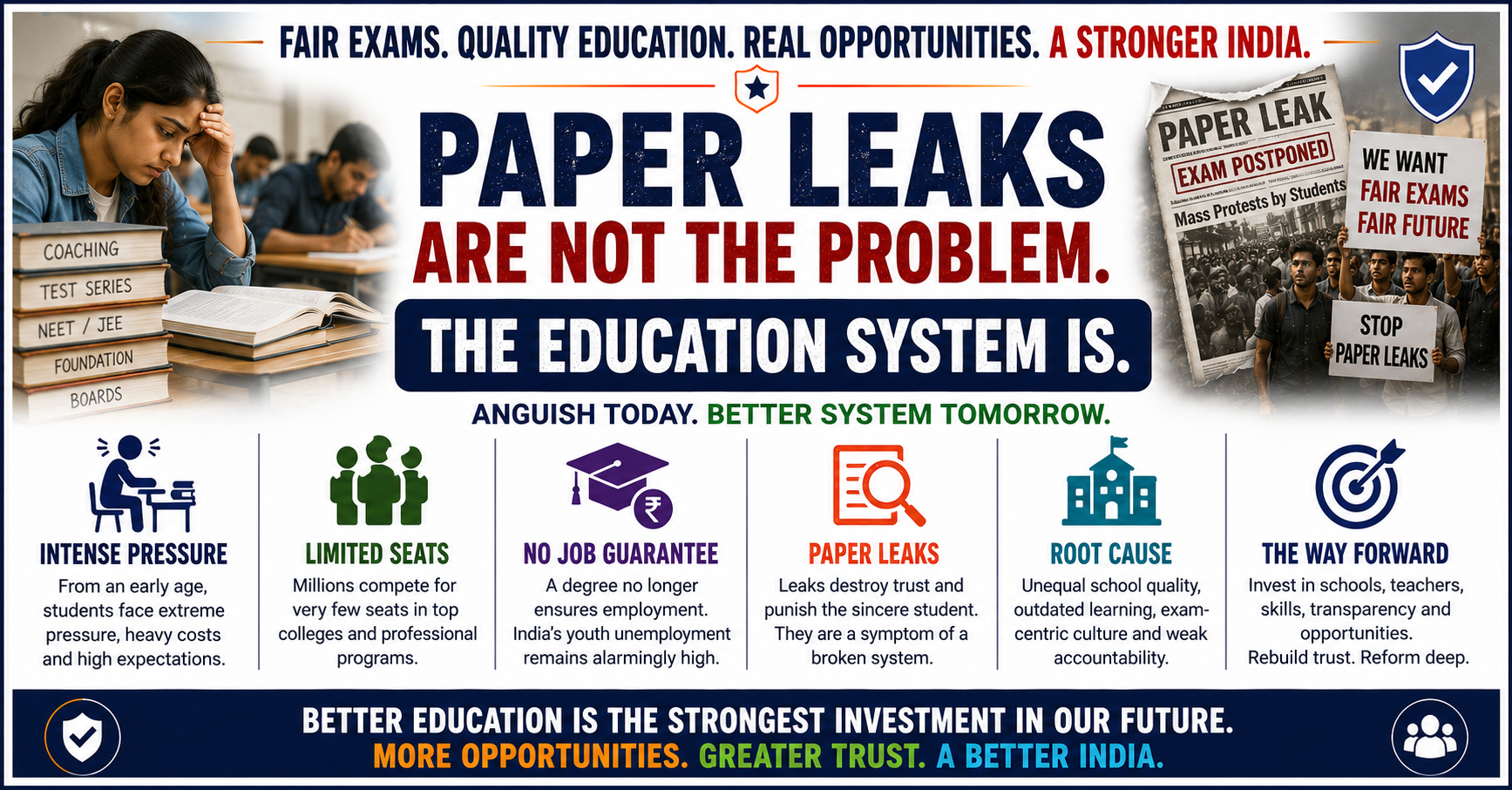
Every few years, India is shaken by another examination paper leak.
The headlines change. The examination changes. The investigations begin. Arrests are made. Committees are formed. Promises of reform follow.
Then, after some time, another paper leaks.
This pattern is not new. Reports of examination paper leaks date back to the 1980s. Despite advances in technology, stricter laws, and repeated assurances that such incidents will not happen again, they continue to occur across entrance examinations and government recruitment tests.
If paper leaks have been happening for decades, why does each new incident seem to generate even greater public anger?
Because the protests are no longer just about paper leaks.
They reflect a much deeper frustration with India’s education system.
A Journey Filled With Pressure
For many Indian students, the pressure begins long before they enter college.
Parents invest heavily in private schools, coaching classes, and tuition because they worry that schooling alone may not prepare their children for highly competitive entrance examinations. Students spend years preparing for a handful of exams that often determine the direction of their careers.
Competition itself is not the problem. Every country has competitive universities and professional programs.
The challenge is the combination of extraordinary competition and limited opportunity.
In 2024, more than 2.4 million students registered for the NEET-UG examination, while the number of MBBS seats represented only a fraction of total applicants. Millions of capable students were therefore competing for opportunities that simply did not exist in sufficient numbers.
The result is an education system where a single examination can carry enormous emotional, financial, and professional consequences.
Success No Longer Guarantees Security
Even students who successfully navigate this journey often discover that obtaining a degree is no longer the finish line.
India has made impressive progress in expanding access to higher education, but many graduates continue to struggle in the job market. Employers increasingly seek practical skills, communication ability, digital literacy, and problem-solving capabilities that many graduates have had limited opportunity to develop.
This disconnect is reflected in India’s persistently high levels of youth unemployment, particularly among educated young people.
For students, the message can feel deeply discouraging.
Years of study.
Years of coaching.
Years of financial sacrifice.
Yet no certainty of meaningful employment.
Why Paper Leaks Become a Flashpoint
Viewed in isolation, a paper leak appears to be an examination security failure.
Viewed in context, it represents something much larger.
When families invest years of effort and significant financial resources into preparing for a single examination, they expect one thing above all else: a fair process.
Any suggestion that the examination itself may have been compromised undermines confidence not only in that test but in the broader promise that hard work and merit will be rewarded.
That is why every new paper leak produces such an emotional response.
The protests are not simply about one examination.
They are about trust.
There Is No Quick Fix
Calls for tougher punishments, stronger cybersecurity, or stricter examination procedures are understandable.
These reforms are necessary.
But they are unlikely to solve the underlying problem on their own.
Paper leaks are symptoms of a system under extraordinary pressure.
When millions of students compete for relatively few opportunities, when a single examination determines future prospects, when families feel compelled to spend heavily on coaching, and when employment remains uncertain even after graduation, the incentives for malpractice inevitably increase.
The solution, therefore, cannot begin and end with examination security.
Reform Must Start Much Earlier
If India wants to restore confidence in its education system, reform must begin long before students enter an examination hall.
It requires sustained investment in improving learning outcomes in schools, strengthening teacher quality, modernizing curricula, expanding access to high-quality universities, improving vocational education, and creating assessments that reward understanding rather than memorization.
Equally important, India must continue expanding economic opportunities so that a student’s future does not depend disproportionately on the outcome of a single examination.
None of these reforms will be inexpensive.
Nor will they produce results overnight.
A Question of National Priorities
Education is often described as an investment in the future.
Yet meaningful reform requires governments to make difficult choices about where public resources are allocated.
Building a world-class education system demands sustained investment over decades. That may require governments to reconsider existing spending priorities and identify areas where resources can be redirected toward strengthening India’s most important long-term asset—its people.
Doing so will require political courage.
It will also require challenging long-established ways of thinking.
Looking Beyond the Headlines
Paper leaks deserve serious attention because they undermine fairness and public confidence.
But if our response is limited to preventing the next leak, we risk treating the symptom while ignoring the disease.
The real challenge is creating an education system that gives every student confidence that sincere effort, genuine ability, and hard work will be rewarded with meaningful opportunities.
India’s young people are not asking for guaranteed success.
They are asking for a system they can trust.
And if India hopes to build a more prosperous and innovative future, rebuilding that trust may be one of the most important investments the country can make.
Leave a Reply