
Every year, millions of Indian children walk into classrooms carrying the hopes of their families. Parents make enormous sacrifices because they believe education is the surest path to a better life. Yet for many students, the system they enter is unable to provide even the most basic conditions for learning.
The challenge is not a lack of talent. India has some of the brightest young minds in the world. The challenge is that we often expect world-class outcomes from a system that invests far less per student than many of the world’s leading education systems.
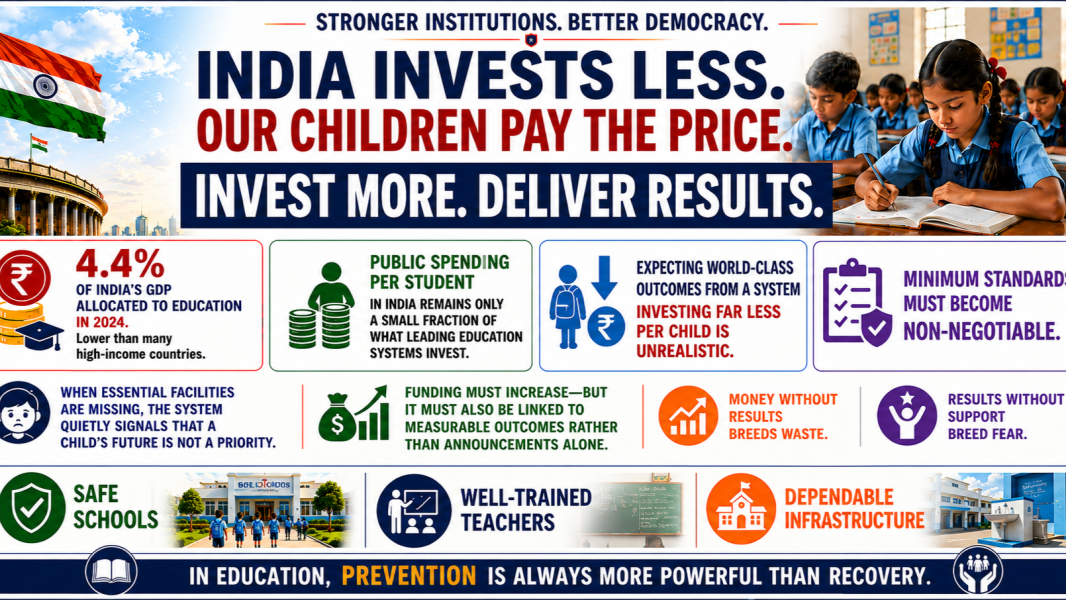
In 2024, India allocated about 4.4% of its GDP to education, below the levels seen in many high-income countries. More importantly, public spending per student remains only a small fraction of what these countries invest. While money alone does not guarantee success, expecting outstanding educational outcomes without adequate investment is equally unrealistic.
Education should not be viewed as a cost to be minimized. It is one of the most important long-term investments a nation can make. Every child who receives a quality education contributes to a more productive workforce, stronger institutions, higher incomes, better public health, and greater social stability. Conversely, every child who leaves school without the skills needed for modern life represents a loss not only for that individual but for the country’s future.
Underfunding often reveals itself in ways that should never be considered acceptable. Schools with locked or unusable toilets. Classrooms that are overcrowded or structurally unsafe. Laboratories without equipment. Libraries without books. Teachers responsible for far too many students. Children who are physically present in school but leave without mastering basic reading, writing, or mathematics.
These are not isolated inconveniences. They send a powerful message about national priorities. When essential facilities are missing, the system quietly tells children that their future is not important enough to deserve better.
At the same time, increasing budgets alone will not solve the problem. Around the world, examples exist of education systems that spend significant amounts without producing strong learning outcomes. Funding must therefore be accompanied by clear goals, transparent measurement, and accountability for results.
Governments should regularly publish meaningful indicators such as literacy and numeracy outcomes, attendance, teacher vacancies, infrastructure quality, learning growth, and school completion rates. Citizens deserve to know not only how much money has been allocated but also what that investment has achieved.
Accountability, however, should not become a mechanism for assigning blame without providing support. Schools cannot be expected to deliver exceptional results while lacking qualified teachers, learning materials, safe facilities, or basic infrastructure. Likewise, simply increasing budgets without measuring outcomes risks creating inefficiency and waste.
India needs both.
Money without results breeds waste.
Results without support breed fear.
A successful education system balances sustained investment with honest accountability. It provides schools with the resources they need while ensuring that every rupee contributes to better learning outcomes for students.
The ultimate goal is not simply to build more schools or increase spending figures. It is to ensure that every child—regardless of where they are born—has access to a safe learning environment, competent teachers, modern resources, and the opportunity to develop the knowledge and skills needed to succeed.
India’s future will not be determined by the size of its population alone. It will be determined by how well that population is educated.
If we want India to become one of the world’s leading economies in the decades ahead, education cannot remain just another budget item. It must become one of our highest national priorities. Investment is essential, but investment must be matched by measurable outcomes, transparency, and continuous improvement.
Because the true cost of underfunding education is not measured in budgets—it is measured in unrealized human potential.
Leave a Reply