
Education has always been one of the most powerful drivers of economic growth and social mobility. For millions of Indian families, a college degree represents hope—the belief that education will lead to better opportunities, higher incomes, and a better quality of life. Expanding access to higher education has therefore been an important achievement for India.
However, the next challenge is no longer simply getting more students into colleges. It is ensuring that higher education prepares graduates to succeed in a rapidly changing economy.
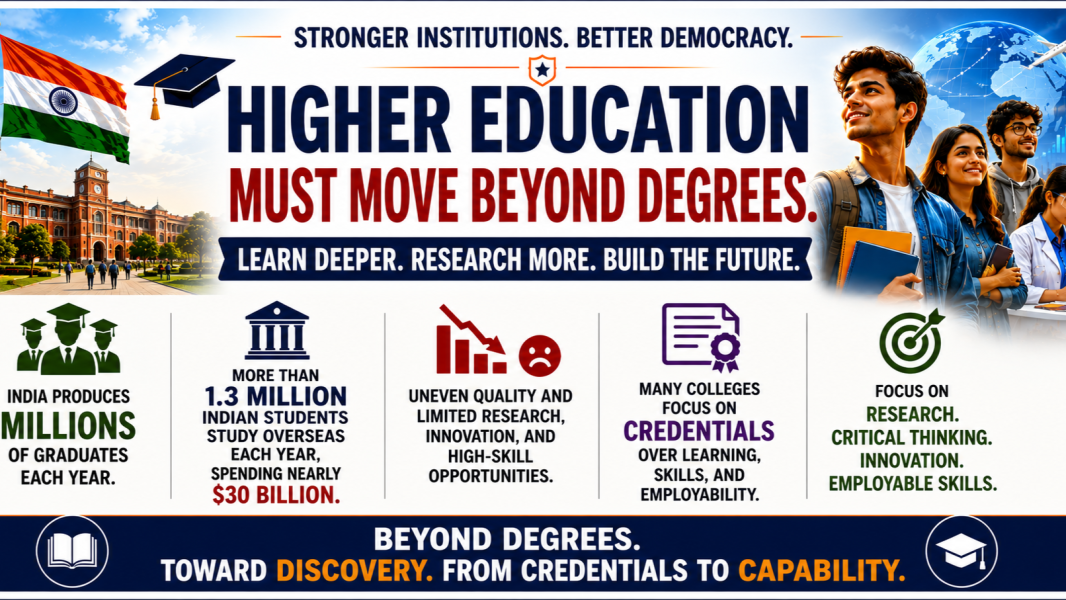
India now produces millions of graduates each year, yet many employers continue to report difficulty finding candidates with the practical skills, critical thinking, communication abilities, and problem-solving capabilities they need. At the same time, many graduates struggle to find meaningful employment despite holding degrees. This disconnect between education and employment benefits neither students nor employers.
India is also fortunate to have institutions such as the IITs, NITs, IIMs, AIIMS, IISc, and several outstanding universities that produce graduates who compete with the very best in the world. Their success demonstrates that Indian students possess exceptional talent when provided with world-class education and opportunities.
Yet these institutions educate only a small fraction of India’s students. Across much of the higher education system, quality remains uneven. Many colleges continue to focus primarily on awarding degrees rather than developing the knowledge, practical skills, research capability, and innovative thinking needed in today’s economy.
The consequences extend beyond employment. Every year, more than 1.3 million Indian students choose to pursue higher education overseas, collectively spending nearly $30 billion. Many of these students later build successful careers abroad because those countries offer stronger research ecosystems, greater innovation, and more high-skilled employment opportunities.
This should not be viewed as a criticism of students who choose to study overseas. International education broadens perspectives and strengthens global collaboration. The real question is why so many talented students believe they must leave India to pursue world-class education, research, or career opportunities.
A modern higher education system should do far more than prepare students for examinations. It should cultivate curiosity, encourage independent thinking, foster innovation, and develop the ability to solve complex real-world problems. Universities should become centers of research, entrepreneurship, industry collaboration, and lifelong learning rather than institutions primarily focused on granting credentials.
Achieving this transformation will require sustained investment in faculty development, research infrastructure, laboratories, academic freedom, and stronger partnerships between universities and industry. It will also require greater accountability for educational outcomes so that institutions are measured not only by enrollment or graduation rates, but by the quality of education they provide and the opportunities they create for their students.
India has one of the world’s youngest populations. This demographic advantage can become one of the country’s greatest strengths, but only if higher education equips graduates with the skills, knowledge, and confidence to innovate, create new industries, and compete globally.
Degrees will always matter. They recognize years of hard work and learning. But degrees alone cannot build a prosperous nation. India’s future will depend not on how many graduates it produces, but on how well its education system prepares them to think critically, innovate boldly, and contribute meaningfully to society.
Leave a Reply