
On August 15, 2026, as India marks 79 years of independence, it is worth looking beyond the celebration of headline GDP and asking a more fundamental question:
How much of India’s economic progress has translated into a better life for ordinary Indians?
There is little doubt that India has grown. The economy is substantially larger than it was a decade ago. New infrastructure has been built, technology has transformed daily life, businesses have expanded, and India’s importance in the global economy has increased.
But economic growth is ultimately a means, not an end.
For most citizens, progress is measured differently: Can my income buy more? Can I afford a better home? Can I educate my children? Can I access good healthcare? Can I find a productive job? And is the country becoming financially stronger for the next generation?
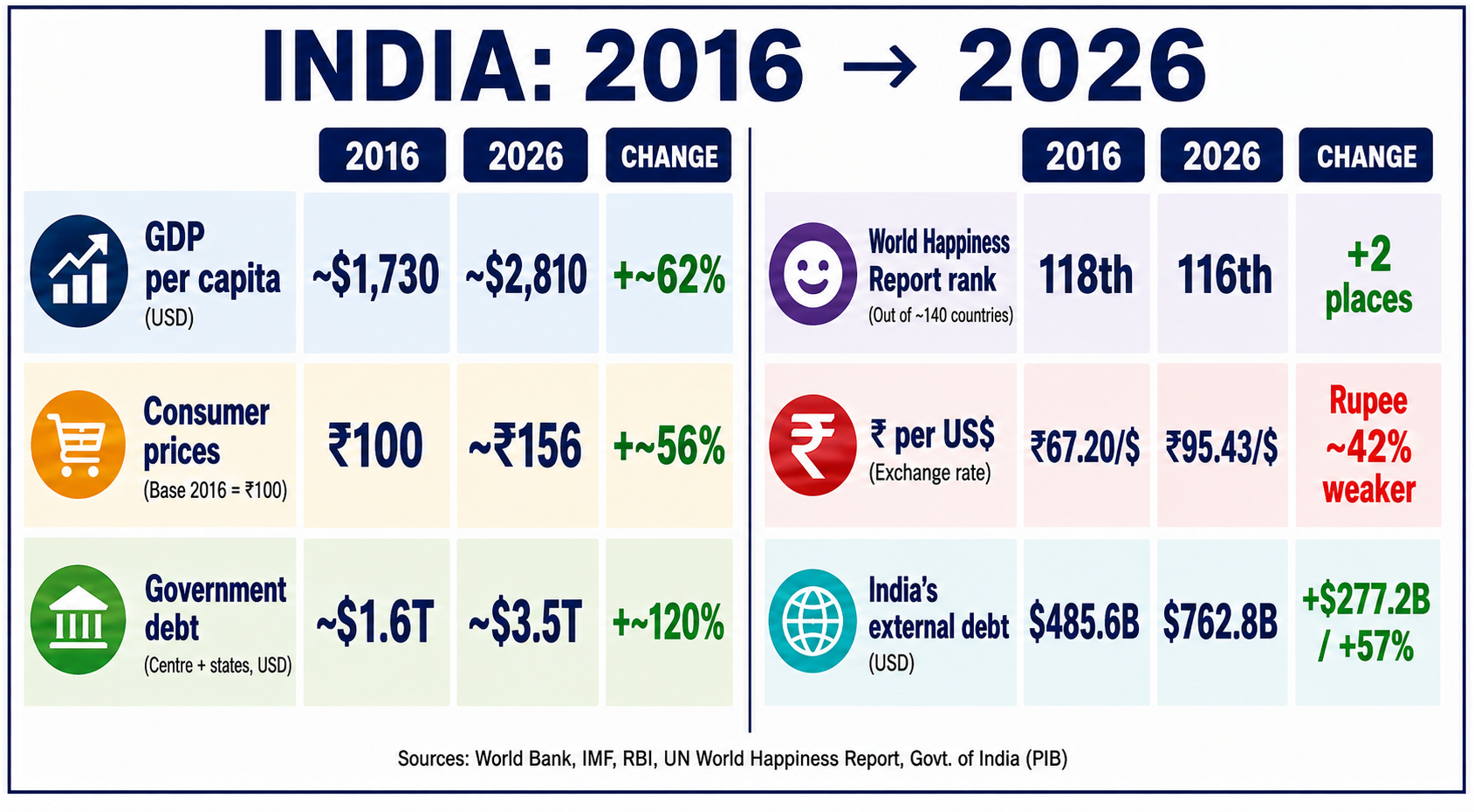
Looking at a few basic numbers from 2016 to 2026 produces a more complicated picture.
GDP per Capita Grew 62%—But Prices Rose 56%
India’s nominal GDP per capita increased from approximately $1,730 in 2016 to $2,810 in 2026, a 62% increase.
That sounds impressive on its own.
But during roughly the same period, cumulative consumer price inflation was around 56%. Put simply, something represented by a ₹100 basket in 2016 would cost roughly ₹156 today.
This is not a direct calculation of real household income—GDP per capita and household income are different measures. But the comparison raises an important question about how much of headline economic growth has translated into substantially greater purchasing power for ordinary citizens.
India has created considerable new wealth over the decade. The more important challenge is ensuring that prosperity spreads broadly enough for hundreds of millions of families to feel the difference in their everyday lives.
Government Debt Has Grown Even Faster
There is another side to the balance sheet.
Combined government debt—Center and states—has increased from roughly $1.6 trillion to around $3.5 trillion over the decade.
That is an increase of approximately 120%.
Debt itself is not necessarily bad. Governments borrow to build roads, railways, power systems, schools, hospitals and other productive assets. If borrowing creates infrastructure and institutions that raise future productivity, future generations inherit both the debt and the assets that help pay for it.
The question, therefore, should not simply be how much India borrowed.
It should be:
What return did Indians receive from that borrowing?
Every rupee of public debt ultimately needs to be serviced through future government revenues. We therefore owe it to the next generation to ensure that borrowed money creates enduring economic capacity rather than merely financing today’s expenditure.
The Rupee Tells Another Story
In 2016, one US dollar cost roughly ₹67. In August 2026, it costs approximately ₹95.
That means the rupee has depreciated by roughly 42% against the dollar, measured by the additional rupees required to purchase one dollar.
Currency depreciation has many causes and should not be interpreted in isolation. India’s inflation differential relative to other countries, interest rates, capital flows, trade, oil prices, and global monetary conditions all matter.
But a weaker currency does have consequences. Imported energy, technology, machinery, overseas education, and international travel are becoming more expensive for Indians.
For a country aspiring to become substantially wealthier, the long-term objective must ultimately be to build productivity and competitiveness strong enough to support both rising incomes and a resilient currency.
External Debt Has Also Increased
India’s external debt increased from approximately $486 billion in 2016 to $763 billion in 2026—an increase of around $277 billion, or 57%.
Again, the number by itself does not establish whether borrowing was good or bad. External debt needs to be considered relative to the size of the economy, foreign-exchange reserves, debt-service requirements, and what the borrowed capital financed.
But it belongs on the national balance sheet.
Economic progress should not be judged only by the assets and income we create. We should also examine the liabilities accumulated along the way.
And Are Indians Happier?
Perhaps the most interesting number is not financial at all.
India ranked approximately 118th in the World Happiness Report in 2016. In 2026, it ranks 116th.
After a decade of enormous economic and technological change, India’s relative position has barely moved.
Happiness rankings have limitations and should never substitute for economic statistics. Yet they remind us of something easily lost in discussions about trillion-dollar economies:
Development is ultimately about people.
Income matters. But so do health, education, safety, clean air and water, functioning cities, opportunity, community, trust in institutions, and confidence about the future.
Growth Is Necessary. But What Kind of Growth?
None of these numbers means India has failed.
India has made genuine progress over the past decade, and any fair assessment should recognize it. Millions have gained access to infrastructure, financial services, technology and economic opportunities that previous generations did not have.
Nor do these six indicators tell the entire story. GDP per capita, inflation, government debt, external debt, exchange rates and happiness rankings measure different things, and most are national indicators rather than measures specifically of the bottom 90%.
But taken together, they suggest that headline GDP alone is an inadequate national report card.
The next stage of India’s development should be judged by something more demanding:
How rapidly are the lives of ordinary Indians improving?
That means building world-class public education and healthcare. It means creating millions of productive jobs rather than simply employment of any kind. It means reliable electricity, clean water, efficient public transportation, safer communities and functioning local infrastructure.
It also means strengthening the institutions that make prosperity sustainable—courts, policing, regulation, local government, universities and competitive markets.
And every rupee the government spends or borrows should ultimately face a simple test:
Did it make Indians more productive, prosperous and secure?
India’s economy has grown enormously over the past decade. That deserves recognition.
But the ambition for the next decade should be greater than making India a larger economy.
It should be to make Indians substantially more prosperous.
Because ultimately, the size of an economy is only one measure of progress.
The lives of its people are the real report card.
Leave a Reply