
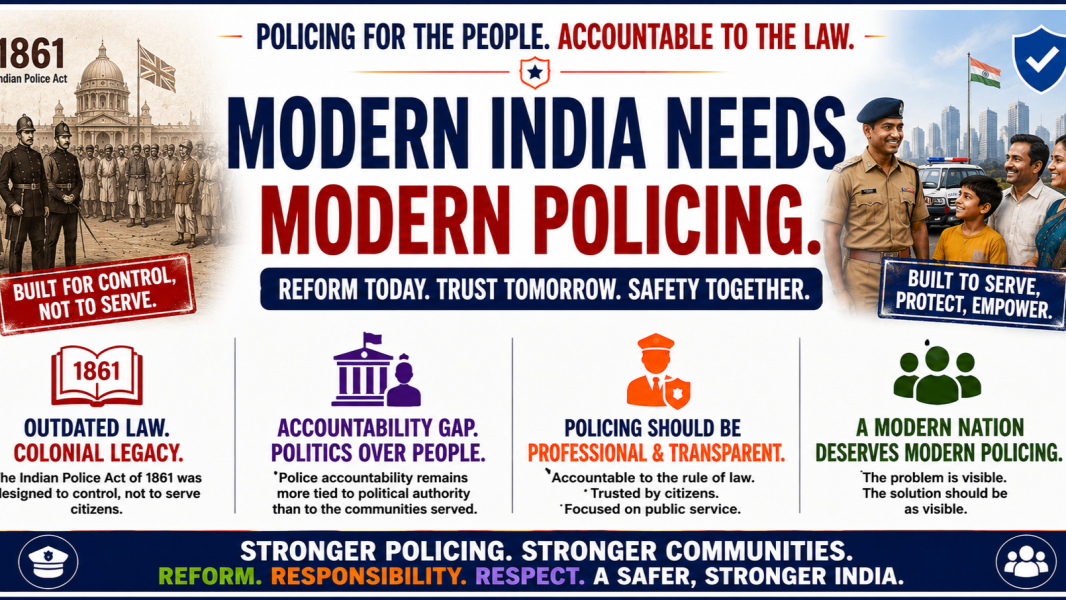
India aspires to become a developed nation. Its cities are expanding, its economy is becoming increasingly sophisticated, and technology is transforming almost every aspect of daily life.
Yet one of the institutions most fundamental to a functioning society—the police—still carries the legacy of a system created during colonial rule.
The Indian Police Act of 1861 was enacted by the British in the aftermath of the 1857 rebellion. Its purpose reflected the needs of a colonial government: maintaining order and exercising authority over the population.
Independent India inherited this structure. Although policing laws and practices have evolved considerably since then, the underlying institutional culture in many parts of the country has been much slower to change.
That matters because policing is not simply about crime. Law and order is the foundation upon which economic opportunity, personal freedom, and public trust are built.
From Authority to Public Service
In a democracy, the relationship between citizens and the police should be fundamentally different from that of a colonial state.
The police should exist to protect citizens, enforce laws fairly and maintain public order—not to serve whichever political authority happens to be in power.
A citizen reporting a crime should expect professional treatment.
A woman walking home should expect to feel safe.
A business owner should expect protection from theft and extortion.
A driver should expect traffic laws to apply equally to everyone.
And someone accused of wrongdoing should expect due process rather than arbitrary treatment.
These should not be aspirations. They should be basic service standards.
Modern policing therefore requires changing the institutional relationship from authority over citizens to service for citizens.
Professionalize the Police
India needs policing to become a highly professional public service.
Recruitment should increasingly emphasize education, aptitude, integrity and public-service orientation. Training should extend beyond physical fitness and criminal law to investigation techniques, technology, evidence collection, conflict resolution, communication and constitutional rights.
Specialized crimes require specialized expertise.
Cybercrime cannot be investigated with yesterday’s tools. Financial fraud requires investigators who understand modern banking and digital transactions. Crimes against women and children require trained personnel and appropriate investigative processes.
Just as medicine and engineering have become increasingly specialized professions, modern policing must evolve with the society it protects.
Separate Policing From Political Influence
One of the most important reforms is institutional independence.
Elected governments must establish laws and public-safety priorities, but individual investigations and enforcement decisions should not depend upon political connections.
Police officers need clearly defined authority, professional standards and reasonable security of tenure so that doing their jobs properly does not depend upon satisfying political interests.
The principle should be straightforward:
Government makes the law. Police enforce the law. Courts interpret the law.
Each institution must be accountable, but each must also be able to perform its constitutional role professionally.
Make Accountability Visible
Greater independence must come with greater accountability.
Modern technology makes this possible.
Body-worn cameras can create an objective record of interactions between police and citizens. Police vehicles can use cameras and GPS. Complaints against officers can be digitally recorded and tracked. Evidence can increasingly be documented electronically.
Every police station should also operate against measurable public-service standards.
How quickly are emergency calls answered?
How long does it take to register a complaint?
How many cases remain unresolved?
How long do investigations take?
How many citizen complaints are filed against the department, and how are they resolved?
Aggregated performance information should be publicly available through dashboards so citizens can evaluate the institutions serving them.
Transparency changes accountability from an occasional investigation into an everyday feature of government.
Enforce the Law Consistently
India does not always suffer from an absence of laws. Too often, it suffers from inconsistent enforcement.
Traffic rules are ignored until enforcement drives begin. Illegal construction continues until a tragedy occurs. Noise restrictions appear during particular periods and disappear afterward. Encroachments are tolerated for years and then suddenly removed.
When enforcement becomes discretionary, citizens learn that rules are negotiable.
A modern policing system must make enforcement predictable.
The objective should not be harsher policing. It should be fairer and more consistent policing.
Technology can help remove discretion from routine enforcement. Cameras can identify traffic violations. Digital records can track repeat offenders. Automated systems can reduce opportunities for roadside negotiation or corruption.
When citizens know that the same rule applies to everyone, compliance itself begins to improve.
Bring Policing Closer to Communities
India’s size also makes centralized policing insufficient.
Local police stations should become genuine community institutions. Officers should know the neighborhoods they serve, understand recurring problems and work with residents before those problems become crises.
Cities and districts should have clearly defined public-safety objectives, while national and state systems provide common standards, training, databases and technology.
The police officer citizens encounter should not represent a distant bureaucracy. That officer should represent a professional local institution accountable for making the community safer.
Invest in Capacity
None of this can happen without investment.
Police departments need sufficient personnel, modern stations, forensic laboratories, vehicles, communications systems, digital infrastructure and continuous training.
Investigators overloaded with cases cannot conduct careful investigations. Police stations operating with inadequate facilities cannot provide modern public service. Courts cannot deliver justice if investigations and evidence collection are weak.
Public safety is not an expense governments should minimize. It is essential national infrastructure.
Businesses invest where contracts and property are protected. Women participate more freely in the economy when public spaces are safe. Tourism grows when visitors feel secure. Communities prosper when citizens trust the institutions responsible for protecting them.
Better policing therefore produces economic as well as social returns.
The Police India Deserves
India does not need to reinvent policing.
Democracies around the world have developed many of the institutions required for professional policing: operational independence, specialized training, modern forensic capabilities, technology-based enforcement, transparent performance measures, community policing and independent mechanisms for accountability.
India can study what works, adapt those lessons to its enormous scale and build something suited to its own democracy.
The transformation should ultimately be simple in purpose.
A ten-year-old should grow up believing that a police officer is someone to approach for help.
A woman should be able to travel without fear.
A citizen should be able to report a crime without influence or connections.
And every Indian—rich or poor, powerful or powerless—should expect the law to be applied in the same way.
More than seventy-five years after independence, India’s policing institutions should fully reflect the democracy they now serve.
A modern India deserves a modern police force: professional in its work, independent in its judgment, transparent in its performance, accountable for its conduct, and unwavering in applying the law equally to everyone.
Leave a Reply