
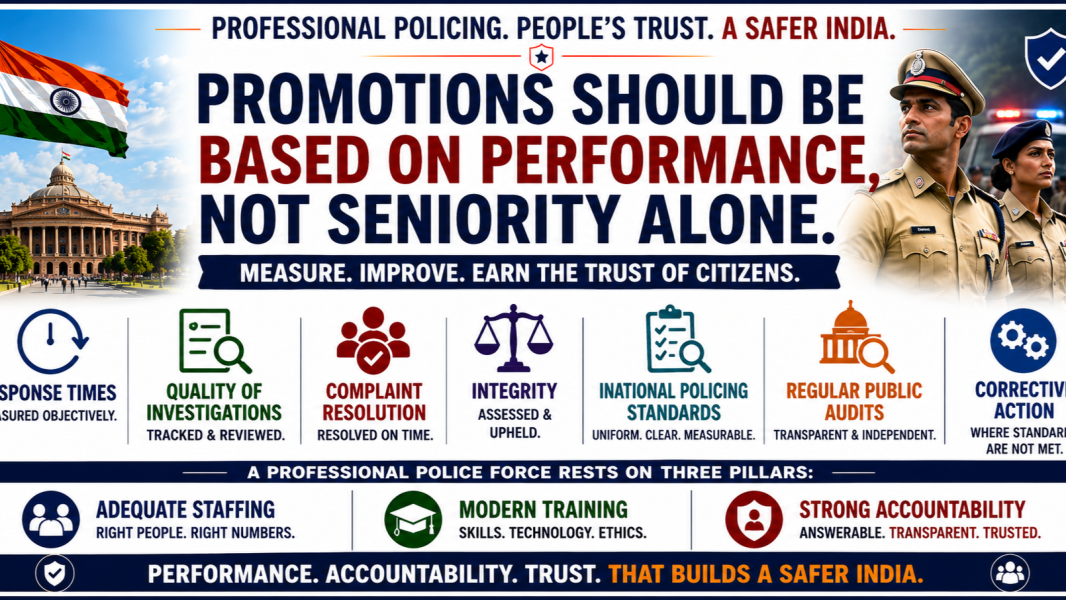
A professional police force cannot be built on recruitment and training alone. It must also have a system that recognizes good performance, rewards integrity, identifies weaknesses, and holds every level of the organization accountable for results.
Police officers perform one of the most difficult functions of government. They respond to emergencies, investigate crimes, maintain public order, protect vulnerable citizens, and exercise significant authority over people’s lives.
Yet if career progression depends largely on years of service rather than demonstrated performance, the system provides too little incentive to distinguish exceptional policing from ordinary performance.
India should progressively build a police system in which merit, competence, integrity, and results play a much greater role in career advancement.
Make Performance Matter
Seniority has an important place in any disciplined organization. Experience matters, particularly in policing.
But experience alone should not determine who advances.
Police officers should be evaluated using clearly defined professional standards. These could include response times, quality and timeliness of investigations, complaint resolution, knowledge of the law, treatment of citizens, disciplinary record, leadership, integrity, and ability to resolve difficult situations appropriately.
Not every aspect of policing can be reduced to a number. Nor should officers be encouraged to chase statistics at the expense of good judgment.
But measurable performance, combined with professional evaluation, can provide a much more complete picture of an officer’s contribution than seniority alone.
Good officers should know that exceptional work will be recognized and rewarded.
Measure the Quality of Investigations
Registering a case is only the beginning of the criminal justice process.
The quality of the investigation often determines what happens afterward. Evidence must be properly collected and preserved. Witnesses must be interviewed professionally. Digital and forensic evidence must be handled correctly. Investigations must be completed within reasonable timelines, and the resulting case must withstand judicial scrutiny.
Police performance should therefore include measures of investigative quality, not simply the number of cases registered or disposed of.
Where investigations repeatedly fail because of poor procedures, inadequate training, or weak supervision, the objective should be to identify the cause and correct it.
Accountability should improve the institution, not merely assign blame.
Establish National Professional Standards
Citizens should be able to expect a basic standard of policing regardless of where in India they live.
India should develop national professional benchmarks covering areas such as emergency response, investigation procedures, evidence handling, citizen complaints, use of force, officer training, technology, ethical conduct, and service standards.
States would continue to administer their police forces, but common benchmarks could establish a minimum level of professional performance citizens should be entitled to expect.
Standards are useful only when they are measured. Police organizations should therefore undergo regular audits against these benchmarks, with key results made publicly available.
Where standards are not being met, there should be a defined corrective plan, a designated responsibility for implementation, and a subsequent review.
Build Accountability Into the System
Accountability should operate at every level.
An individual officer should be responsible for professional conduct. A station commander should be accountable for the performance of the police station. Senior leadership should be responsible for whether districts and units meet established standards.
This creates something government institutions often lack: clear ownership of outcomes.
Citizens should also have simple, transparent mechanisms to file complaints, track their resolution, and understand the expected timelines.
When performance is visible, and responsibility is clear, problems become harder to ignore.
Give Officers the Resources to Meet Higher Standards
It would be unfair to demand better performance from police officers without providing them with the resources they need to deliver it.
Many police personnel work under enormous pressure, with staffing shortages, long hours, inadequate technology, growing cybercrime, expanding responsibilities, and difficult working conditions.
Accountability must therefore be accompanied by investment.
Police stations need adequate staffing. Officers need continuous professional training. Investigators need modern forensic and digital tools. Technology should reduce administrative work. Mental health and stress management support should become part of professional policing.
Higher expectations and better resources must advance together.
Build Careers Around Professional Excellence
A merit-based system can also change the culture of policing.
When officers see that integrity, investigative competence, leadership, citizen service, and professional development influence career progression, the institution begins rewarding the behavior it wants to reproduce.
Promotions should therefore increasingly consider demonstrated performance alongside experience and seniority.
Equally important, officers who consistently perform well should have access to specialized training and leadership opportunities, while persistent performance problems should trigger additional training, supervision, or appropriate corrective action.
The objective is not to create competition for statistics. It is to create a culture in which professional excellence matters.
Three Foundations of Professional Policing
Ultimately, professional policing rests on three foundations: adequate staffing, modern training, and strong accountability.
Remove any one of them and the system weakens.
Accountability without resources becomes unfair. Resources without training produce limited improvement. Training without accountability provides little assurance that standards will be maintained.
India needs all three.
A modern police force should give its officers the resources, education, training, and professional respect necessary to perform difficult jobs well. In return, citizens should be entitled to measurable standards of competence, integrity, responsiveness, and accountability.
A professional police force is not built simply by giving officers authority. It is built by creating a system in which good performance is expected, measured, supported, and rewarded.
Better policing requires better systems. And better systems build a stronger India.
Leave a Reply