
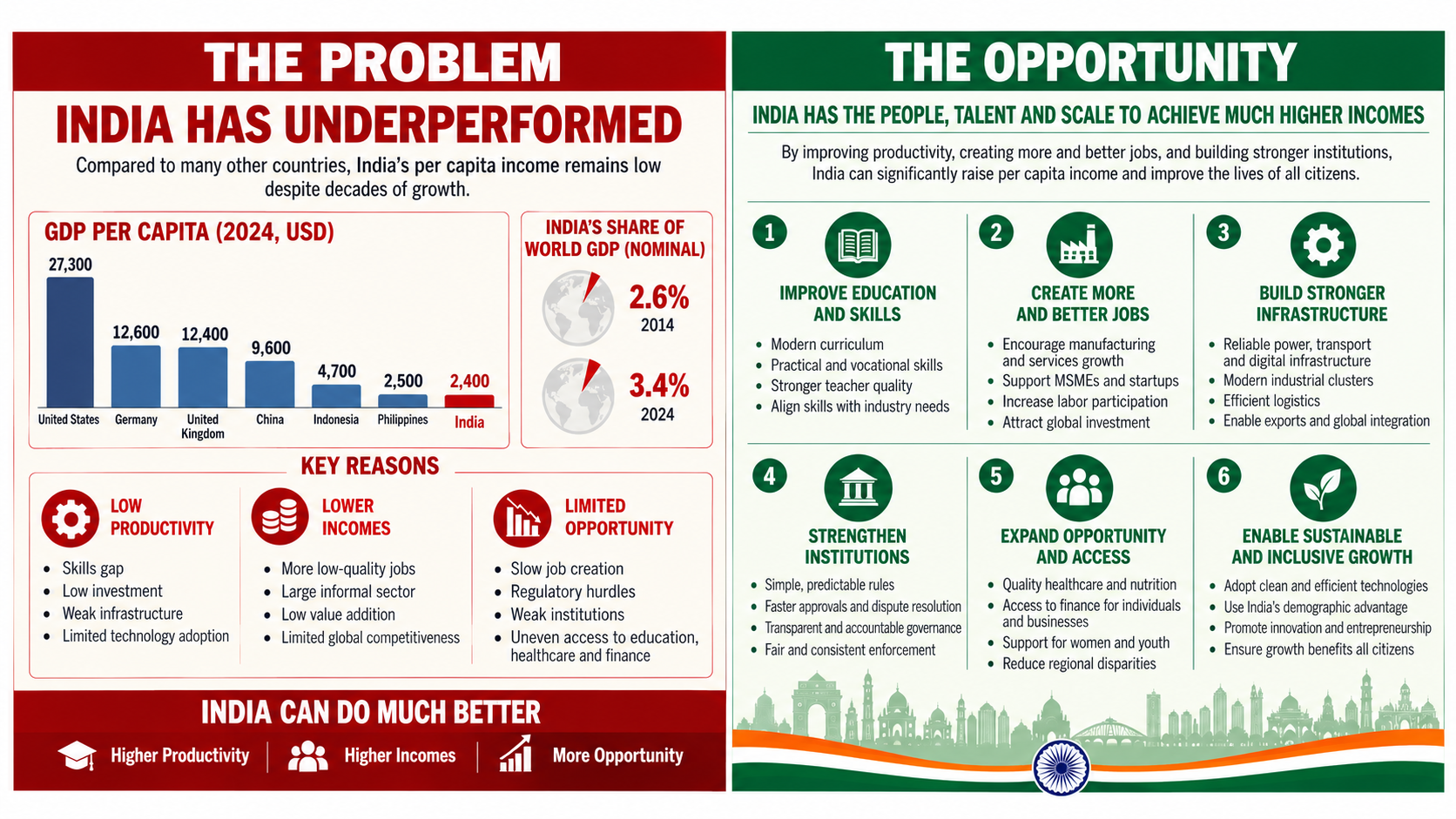
A Roadmap to Higher Productivity, Higher Incomes, and Greater Opportunity
Every Indian deserves the opportunity to build a prosperous life through hard work, talent, and enterprise.
India has no shortage of talent. Our entrepreneurs build global companies. Our engineers power the world’s technology. Our doctors save lives around the world. Our scientists, teachers, farmers, workers, and innovators contribute every day to our nation’s progress.
Yet despite this extraordinary potential, hundreds of millions of Indians continue to struggle with low incomes and limited opportunities.
The question is not whether India has the talent.
The question is whether India has built the institutions that allow that talent to flourish.
That is the idea behind The India We Deserve.
Prosperity Is Built, Not Promised
Nations do not become prosperous by accident.
They become prosperous because they build institutions that educate their people, encourage enterprise, protect competition, uphold the rule of law, and hold public institutions accountable for results.
India has already demonstrated what its people can achieve when given the opportunity.
Imagine what our country could become if every child received an excellent education, every entrepreneur competed on a level playing field, every citizen could rely on efficient public services, and every public institution focused relentlessly on delivering results.
That is the India we should aspire to build.
Looking Beyond GDP
India is one of the world’s largest economies, and the future is full of promise.
But prosperity is not measured only by GDP growth.
For ordinary families, prosperity means something much simpler.
Can I find a quality job?
Can my children receive an excellent education?
Can I start and grow a business without unnecessary barriers?
Can I rely on public institutions to work fairly, efficiently, and transparently?
Can my children have more opportunities than I did?
The answers to these questions ultimately determine whether productivity rises, incomes grow, and opportunities expand.
Why Are Incomes Still Low?
I believe two structural challenges lie at the heart of the problem.

1. A Workforce Skills Gap
A nation’s greatest asset is its people.
The knowledge, skills, creativity, and ambition of its citizens ultimately determine its productivity and prosperity.
Every child deserves an education that prepares them not only to pass examinations, but to think critically, solve problems, innovate, and adapt to a rapidly changing world.
Yet many employers struggle to find workers with the skills they need, while millions of graduates struggle to find meaningful employment.
Weak learning outcomes, inconsistent teaching standards, limited accountability, underinvestment, and recurring examination leaks have contributed to a widening gap between what students learn and what the modern economy demands.
This skills gap limits productivity, slows innovation, reduces competitiveness, and ultimately constrains incomes.
History offers an important lesson.
Countries that have achieved sustained prosperity have treated education as a long-term national investment.
The United States, for example, spends approximately $18,000 per student each year in public K–12 education, although spending varies across states. Beyond school, it has invested for generations in need-based financial aid and a network of land-grant universities that combine education, research, and industry collaboration.
These institutions have produced generations of scientists, engineers, entrepreneurs, doctors, and innovators whose ideas have created entirely new industries and millions of high-productivity jobs.
India does not need to copy another country’s model.
But one lesson remains universal.
Countries that invest in education, research, and human capital create the workforce that drives innovation, productivity, and rising incomes for generations.
Education is not merely a social responsibility.
It is one of the highest-return economic investments a nation can make.
2. Too Few Quality Jobs
Even the world’s best education system cannot deliver prosperity if quality jobs are scarce.
Businesses create productive, well-paying jobs when they have the confidence to invest, innovate, compete, and grow.
That confidence depends upon strong institutions.
It requires predictable regulations, efficient administration, timely justice, reliable infrastructure, fair competition, and public policies that reward long-term investment.
One of the most important questions every nation must answer is:
What is the proper role of government?
The government performs functions that no one else can.
It is responsible for national security, law and order, justice, education, healthcare, infrastructure, environmental protection, and the creation of a regulatory framework that enables citizens and businesses to thrive.
These responsibilities require enormous financial resources, capable leadership, and sustained attention.
When governments also devote significant resources to operating commercial businesses in competitive markets, those same resources become unavailable for their core responsibilities.
Every rupee invested in running a commercial enterprise is a rupee that cannot be invested in better schools, faster courts, modern hospitals, safer cities, or stronger infrastructure.
There is another challenge.
When government is both the rule-maker and a participant in the marketplace, conflicts of interest can arise. Even where decisions are made in good faith, the perception that the regulator is also competing with private enterprise can reduce confidence, discourage investment, and weaken competition.
Competitive markets encourage businesses to innovate, improve quality, lower costs, and create better opportunities for consumers and workers alike.
The government’s greatest contribution is often not operating businesses, but creating fair rules, enforcing them consistently, protecting competition, and focusing relentlessly on the responsibilities that only the government can perform.
When the government governs well, businesses invest with confidence.
When businesses invest, they create productive jobs.
When productive jobs increase, incomes rise.
The Cycle We Must Break
These two challenges reinforce one another.
A workforce skills gap reduces productivity.
Lower productivity discourages investment and limits the creation of quality jobs.
Fewer quality jobs keep incomes low.
Lower incomes reduce household savings and government revenues.
Lower investment limits future growth.
The cycle repeats itself.
Breaking this cycle requires stronger institutions that invest in people while creating an environment where enterprise can flourish.
A Roadmap for Reform
Meaningful progress requires reforms that reinforce one another.

1. Clean Elections
Reduce the influence of private money by ensuring transparent, publicly funded elections.
2. Full Transparency
Require annual public disclosure of assets by elected representatives and senior public officials.
3. Government Focused on Governing
Gradually exit non-strategic commercial businesses so government can concentrate its resources on its core responsibilities.
4. Build Strong Institutions
Invest consistently in education, healthcare, and the judiciary to improve productivity, trust, and opportunity.
5. Fiscal Reform
Empower states and cities with greater financial responsibility, stronger local revenue, and balanced budgets.
6. Local Accountability
Give mayors and city councils greater authority—and greater accountability—to deliver services that citizens depend on every day.
These reforms reinforce one another.
Together they create an environment where businesses invest with confidence, institutions perform effectively, innovation accelerates, and citizens have greater opportunities to succeed.
The Goal
The objective is simple.
Create an India where productivity grows.
Where incomes rise.
Where opportunity is determined by talent and effort.
Where the government focuses on governing.
Where businesses compete fairly.
Where education prepares every child for the future.
Where institutions earn the trust of the people they serve.
In short:
Higher Productivity.
Higher Incomes.
Greater Opportunity.
A Stronger India.
Why I Started The India We Deserve
I started The India We Deserve because I believe India has everything it needs to become one of the world’s most prosperous nations.
The talent already exists.
The ambition already exists.
The entrepreneurial spirit already exists.
What will determine our future is the strength of the institutions we choose to build.
This initiative is not about supporting one political party or opposing another.
It is about encouraging thoughtful, evidence-based discussion on practical reforms that can improve everyday life for every Indian.
History shows that nations prosper when they invest in their people, strengthen their institutions, reward enterprise, uphold accountability, and create an environment where opportunity is available to all.
That future is within India’s reach.
It will not be built overnight.
It will be built through better institutions, better policies, and better choices—made consistently over generations.
That is the conversation I hope The India We Deserve will inspire.
Because every generation has a responsibility to leave its country stronger than it found it.
And that is the India we deserve.
Leave a Reply