
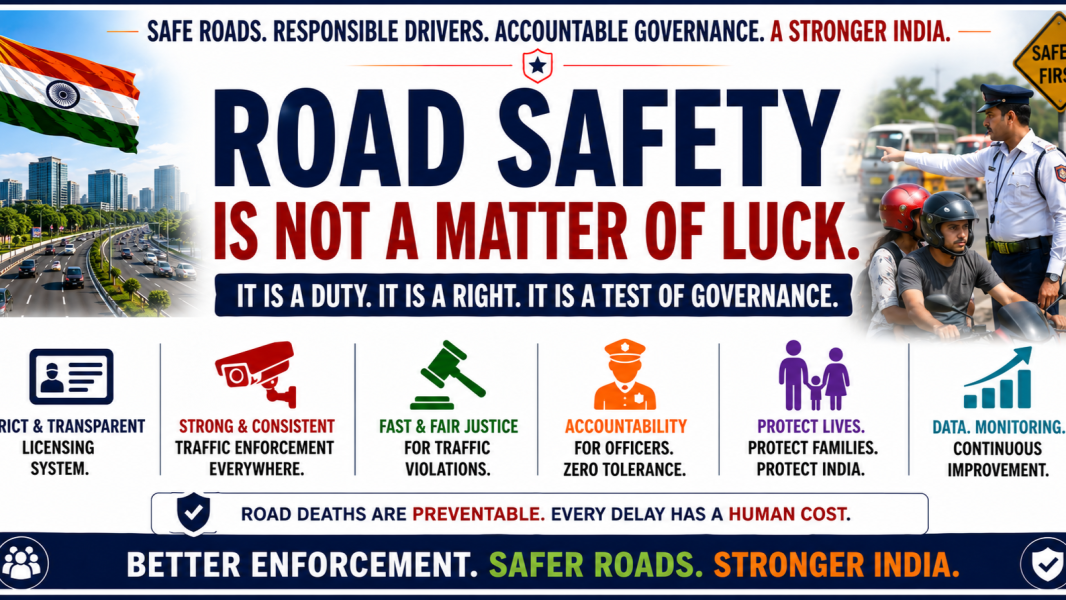
Every time we leave home, we make an assumption: that the roads we travel on are governed by rules.
We assume the person driving toward us has been properly trained and licensed. We assume vehicles are roadworthy. We assume red lights mean stop, speed limits mean something, drunk driving has consequences, and dangerous behavior will be detected and penalized.
For millions of Indians, those assumptions are far less certain than they should be.
Road safety is often discussed as a problem of bad driving. But when dangerous driving becomes widespread, and violations routinely go unchecked, it is no longer simply a problem of individual behavior. It becomes a failure of the system responsible for setting standards, enforcing rules, and protecting citizens.
Road Deaths Are Not Inevitable
India’s enormous road network carries hundreds of millions of people and vehicles. Some accidents will inevitably occur. But there is an important difference between an accident that could not reasonably have been prevented and a death caused by a system repeatedly tolerating predictable risks.
A driver who was never properly trained.
A license issued without demonstrating adequate competence.
A habitual offender who continues driving.
A vehicle operating without meeting safety standards.
Speeding that is rarely detected.
A traffic signal treated as optional because enforcement is absent.
A drunk driver who believes the likelihood of being stopped is negligible.
These are not simply accidents. They are warning signs of systems that have failed to prevent foreseeable harm.
The objective of road-safety policy should therefore not be to respond more effectively after accidents. It should be to systematically reduce the probability that those accidents occur in the first place.
A Driving License Must Mean Something
The first line of defense is licensing.
A driving license should certify that a person has demonstrated the knowledge, judgment, and practical ability necessary to operate a vehicle safely. It should not merely be an administrative document.
India should move toward rigorous, standardized and technology-supported licensing. Applicants should demonstrate knowledge of traffic laws, road signs, pedestrian and cyclist safety, emergency situations and defensive driving, followed by a meaningful practical driving examination.
Testing should increasingly use standardized tracks, digital records and technology to reduce discretion and opportunities for manipulation.
Commercial drivers should face even higher standards because mistakes involving buses, trucks, and other heavy vehicles can be catastrophic.
A simple principle should apply:
No one should be permitted to operate a potentially lethal machine on a public road until they have demonstrated that they can do so safely.
Enforcement Must Become Predictable
Rules work when people expect enforcement.
If a driver believes there is almost no chance of being caught for speeding, jumping a red light, driving in the wrong direction, or using a phone while driving, even severe penalties may have limited deterrent value.
India therefore needs to move away from enforcement that depends primarily on a police officer physically witnessing a violation.
Modern traffic enforcement should increasingly rely on technology: speed cameras, red-light cameras, automatic number-plate recognition, electronic challans and integrated vehicle and license databases.
The objective should not be to collect more fines.
It should be to create a simple expectation in the mind of every driver:
If I break an important traffic rule, there is a high probability that I will be detected.
That certainty can change behavior far more effectively than occasional enforcement drives.
Repeat Offenders Cannot Be Treated Like First-Time Offenders
Not every violation represents the same risk.
Someone receiving a first minor traffic citation should not necessarily be treated like a driver who repeatedly speeds, drives dangerously or ignores traffic signals.
India needs a stronger system linking violations to individual driving records.
Repeated serious offenses should progressively lead to higher penalties, mandatory retraining, license suspension, and, in extreme cases, cancellation.
The driving license should represent a continuing privilege to use public roads responsibly—not a lifetime entitlement regardless of behavior.
Traffic Policing Must Be Professional
Technology can automate enforcement, but it cannot replace professional policing.
Traffic officers need proper training, equipment, staffing and institutional support. Their performance should be measured not simply by how many challans they issue, but by whether roads under their responsibility become safer.
Enforcement should also be consistent.
Rules cannot depend upon who is driving, whom they know, what vehicle they own, or which police officer happens to stop them.
A functioning rule-of-law system requires the same traffic law to apply to everyone.
Road Design Is Part of Enforcement
Drivers are not the only actors responsible for road safety.
Governments also have a duty to build roads that reduce predictable mistakes.
Dangerous intersections, poorly marked lanes, missing pedestrian crossings, inadequate lighting, badly designed median openings, unsafe school zones and confusing signage all increase risk.
Every serious accident should therefore generate more than a police report.
Authorities should ask whether road design contributed to the accident and whether similar accidents are occurring at the same location.
Persistent accident hotspots should trigger mandatory engineering reviews and corrective action.
The question should not merely be:
Who caused this accident?
It should also be:
What can we change so that this accident is less likely to happen again?
Accountability Must Be Measurable
Road safety suffers when responsibility is fragmented among police departments, transport authorities, municipal bodies, highway agencies and other government organizations.
Citizens often cannot tell which institution is responsible for fixing a dangerous intersection, enforcing speed limits, improving street lighting, or correcting unsafe road design.
Government should publish road-safety performance at the city, district and state levels.
Citizens should be able to see where accidents are occurring, where fatalities are increasing, which locations are persistent black spots, what corrective action has been ordered, and whether it has been completed.
Ultimately, somebody must be accountable for outcomes.
Enforcement Is a Public Service
Traffic enforcement is sometimes viewed primarily as punishment.
It should instead be understood as one of government’s most basic public-safety responsibilities.
When a police officer stops a drunk driver, a camera prevents habitual speeding, a licensing authority keeps an incompetent driver off the road, or an engineer redesigns a dangerous intersection, government performs exactly the function citizens should expect: preventing foreseeable harm.
India does not need to invent the principles of safer roads. Countries around the world have demonstrated that stronger licensing, predictable enforcement, safer road engineering, better emergency response, and institutional accountability can dramatically reduce road deaths.
India can adapt these lessons to its own scale and conditions.
The goal should not be roads without traffic violations or accidents. No country can achieve that.
The goal should be a system in which dangerous behavior is increasingly difficult to get away with, dangerous roads are identified and corrected, competent drivers are rewarded with safer roads, and government institutions are held accountable for reducing preventable deaths.
Because when someone leaves home for work, takes a child to school, or travels to visit family, whether they return safely should not depend primarily on luck.
Road safety is not a matter of luck. It measures whether our systems work.
Leave a Reply