
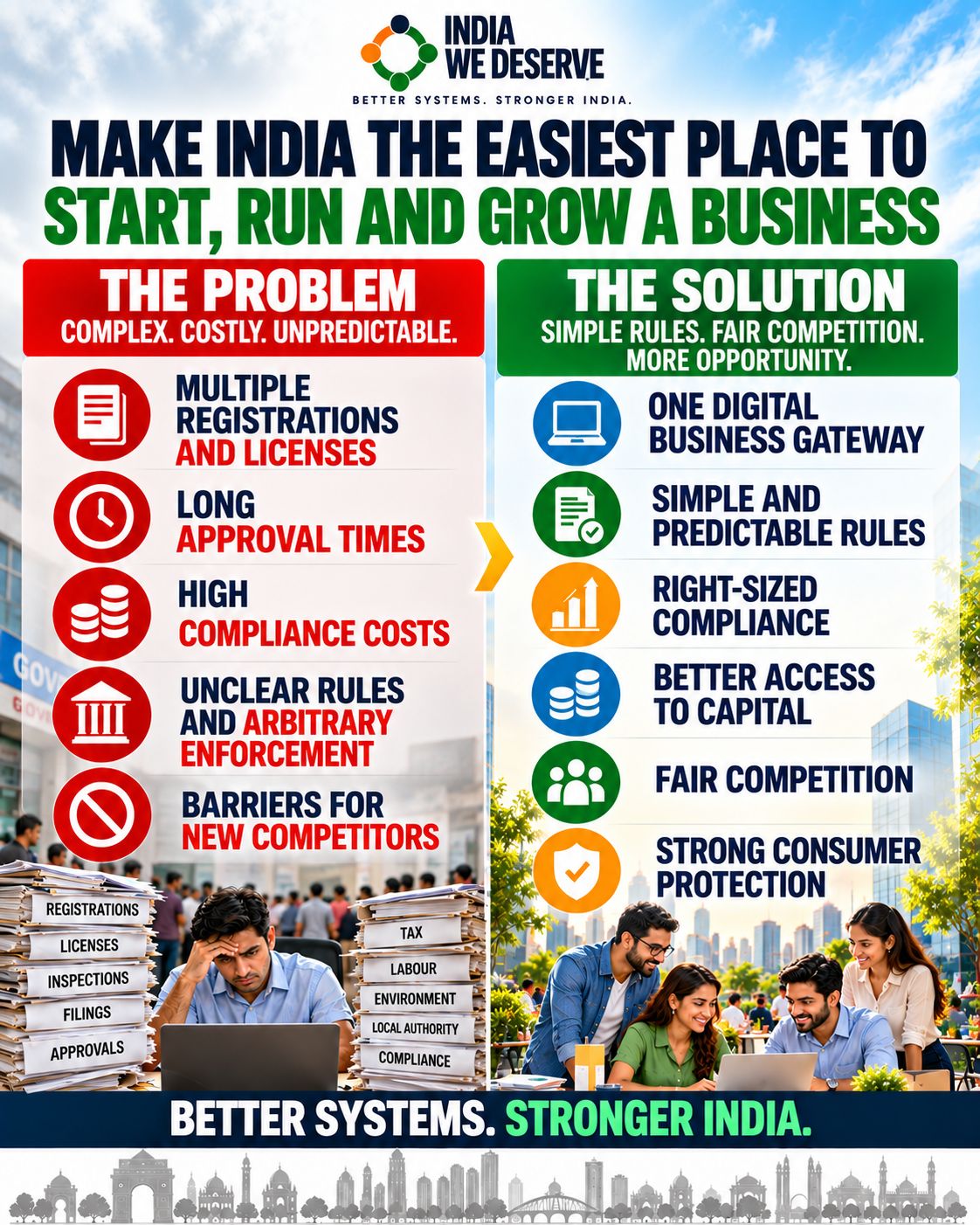
By India We Deserve
India’s entrepreneurial potential is enormous. The systems governing businesses must make it easier to succeed, not harder to begin.
Imagine a young entrepreneur in a small Indian town who wants to start a manufacturing business. She has an idea, some savings, a few potential customers, and the determination to build something of her own.
Before she can concentrate on finding customers, hiring employees, or improving her product, she must understand which registrations, licenses, permissions, and filings apply to her business.
Some requirements come from the central government, others from the state, and still others from local authorities. Each may have its own portal, procedures, documents, and deadlines.
A large corporation can employ lawyers, accountants, and compliance specialists to manage these obligations. A small entrepreneur often has to manage them herself.
The problem is not that India lacks entrepreneurial talent. Too much of that talent can be consumed by navigating the system rather than building a business.
Starting a business should be an opportunity to create something, not an exercise in navigating bureaucracy.
Entrepreneurship Is the Foundation of Economic Opportunity
Every successful business begins with someone willing to take a risk.
It might be a shopkeeper opening a second location, a young engineer developing a new product, a family starting a small factory, or a technology entrepreneur building a company that could eventually serve customers worldwide.
These businesses create employment, introduce competition, develop new products, and contribute to economic growth.
Small businesses matter because they spread economic opportunity across communities. Not everyone can work for a large corporation, and economic development should not depend exclusively on a handful of major companies.
A healthy economy needs businesses of every size, from individual entrepreneurs to globally competitive enterprises.
India has made meaningful progress through digital payments, GST, online company registration, and initiatives such as Udyam. These developments have reduced some barriers to formal business activity.
Yet entrepreneurs still encounter a complicated network of rules and administrative requirements that can vary by industry, location, and business size.
The challenge is no longer simply to digitize individual government procedures. It is to make the entire experience of starting, operating, and expanding a business simpler.
Why Complexity Hurts Small Businesses the Most
Regulation serves legitimate purposes. Governments must protect workers, consumers, public health, the environment, and fair competition.
But every regulation also imposes a cost.
A requirement that appears minor to a large corporation may represent a significant burden for a business employing five people.
Consider the time spent preparing documents, submitting returns, renewing licenses, responding to inspections, or seeking clarification from different government offices.
For a small entrepreneur, that time comes directly at the expense of serving customers, improving products, and growing the business.
Complexity can also discourage businesses from entering the formal economy.
When registration means assuming numerous obligations that are hard to understand or expensive to meet, some entrepreneurs may choose to remain informal.
This limits their access to formal credit, larger customers, government contracts, and expansion opportunities.
Worse, complicated rules can unintentionally protect established businesses. Companies with sufficient resources can absorb compliance costs, while new competitors struggle to enter the market.
A regulatory system intended to protect the public should not become an obstacle that protects established businesses from competition.
Government Should Work as One System
Imagine if an entrepreneur could establish a business through a single digital gateway.
She would provide the required information once. The system would determine which registrations and approvals were necessary, route the information to the appropriate authorities, and maintain a unified record of the business.
Instead of navigating numerous portals, she would have one place to understand her obligations, submit information, receive notifications, and track deadlines.
Different government departments would continue performing their respective responsibilities, but the entrepreneur would no longer have to coordinate among them.
This is a fundamental distinction.
Government agencies may need separate responsibilities, but citizens and businesses should not bear the burden of managing the boundaries between those agencies.
The principle is straightforward:
One Business ID. One Portal. One Compliance Calendar. One Record.
India already has many of the digital capabilities necessary to move in this direction.
The next challenge is connecting these systems across central, state, and local governments while maintaining appropriate safeguards for privacy and data security.
Not Every Business Needs Permission to Begin
One of the most important questions in business regulation is whether an activity genuinely requires advance government approval.
A chemical manufacturing plant, a hospital, and a financial institution present risks that justify substantial regulatory oversight.
But should a small, low-risk business face the same approach?
For many activities, registration and compliance with clearly established rules may be more appropriate than obtaining multiple permissions before operations can begin.
Businesses could be allowed to start through self-certification, with inspections and meaningful penalties for violating applicable standards.
This would not eliminate regulation. It would change how regulation operates.
Instead of assuming that every entrepreneur must obtain permission before acting, the system would establish clear rules and hold businesses accountable for following them.
Where advance approvals remain necessary, requirements, fees, responsible authorities, and decision deadlines should be publicly available.
An entrepreneur should never have to guess what the government expects or how long an approval might take.
The objective is not fewer protections. It is simpler compliance and more effective enforcement.
Small Businesses Should Be Encouraged to Grow
Starting a business is only the beginning.
Many entrepreneurs face an even greater challenge when they try to expand.
They need working capital, equipment, employees, larger facilities, and access to new markets.
Formal credit can be difficult to obtain, particularly for businesses without substantial collateral or a long financial history.
India’s expanding digital economy offers an opportunity to improve this situation.
With appropriate consent and safeguards, reliable records such as tax filings, invoices, and payment histories can help lenders evaluate the financial performance of smaller businesses.
Government procurement can also create opportunities for small enterprises, provided the process is transparent and accessible.
Another important issue is delayed payments.
A large company may be able to absorb a customer taking several months to pay an invoice. For a small supplier, the same delay can threaten its survival.
Prompt-payment requirements and effective dispute resolution can make an enormous difference.
Regulatory policies should also avoid creating incentives for businesses to remain artificially small.
If crossing a particular employment or revenue threshold suddenly triggers disproportionate compliance obligations, entrepreneurs may hesitate to expand.
India should reward businesses for growing, hiring, investing, and becoming more productive.
Competition Must Be Protected
Making it easier to start a business accomplishes little if new companies cannot compete fairly.
Competition encourages businesses to improve quality, reduce costs, innovate, and respond to customers.
But markets do not always remain competitive on their own.
Established companies may seek to protect their positions through exclusive arrangements, anti-competitive practices, or regulations that make entry difficult for newcomers.
Government has an essential responsibility to prevent cartels, abuse of dominant positions, and practices that unfairly restrict competition.
It must also examine whether its own licensing requirements, procurement rules, and administrative procedures create unnecessary barriers.
Regulation should protect the public interest, not shield existing businesses from new competitors.
A young entrepreneur with a better product or service should have a fair opportunity to challenge an established company.
That is how markets remain dynamic.
Consumer Protection Cannot Be Compromised
Simplifying business regulations should never mean weakening consumer protection.
Customers must be protected against unsafe products, fraud, misleading advertising, and unfair commercial practices.
The distinction is between unnecessary administrative requirements and meaningful standards of conduct.
Businesses should find the rules easy to understand and follow, and violations should carry predictable consequences.
Digital complaint systems, transparent resolution timelines, and effective enforcement can help protect consumers without burdening responsible businesses with excessive paperwork.
The ideal system makes compliance straightforward and violations costly.
Compliance should be easier than avoidance.
What India Can Learn From America
The United States provides an instructive example of how entrepreneurship, access to capital, and competition can contribute to economic growth.
Many American businesses can be legally formed through relatively straightforward state registration procedures, although licensing, taxation, employment, and other obligations vary considerably by state and industry.
More importantly, entrepreneurs operate within a financial ecosystem that includes banks, angel investors, venture capital, private equity, and public capital markets.
These institutions provide different sources of financing as businesses develop.
Companies such as Apple, Microsoft, Google, and Amazon began as relatively small enterprises before growing into global corporations.
Their success cannot be attributed to simple registration alone. Access to talent, research, investment, infrastructure, customers, and large markets also played a major role.
The American system is not without problems. Entrepreneurs still face regulatory complexity, financing constraints, and concerns about market concentration.
Nevertheless, its experience shows how an environment that lets new businesses form, raise capital, and challenge established companies can support innovation and economic expansion.
India does not need to copy the American system.
It can build upon its own digital infrastructure, entrepreneurial talent, and growing domestic market while removing unnecessary obstacles throughout the business lifecycle.
The Government’s Role Must Evolve
A strong business environment does not require the absence of government.
It requires a government that performs its responsibilities effectively.
Government should establish clear rules, protect consumers and workers, safeguard the environment, enforce contracts, maintain fair competition, and provide essential infrastructure.
But it should not require entrepreneurs to seek unnecessary permissions at every stage of business activity.
The emphasis should shift from controlling routine commercial decisions to establishing standards and enforcing them consistently.
Technology can simplify compliance, but digitizing a complicated process does not necessarily make it simpler.
A business should not have to complete ten unnecessary forms merely because those forms are now available online.
True reform requires examining why each requirement exists, whether it remains necessary, and whether its purpose can be achieved more efficiently.
Regulations should be reviewed periodically, with outdated or duplicative requirements simplified or eliminated.
Government performance should be measured not by the number of licenses issued or inspections conducted, but by how effectively it protects the public while enabling legitimate businesses to operate.
The India We Deserve
India aspires to become one of the world’s leading economies. Achieving that ambition will require millions of entrepreneurs to establish businesses, create employment, develop new products, and expand into larger markets.
Large corporations will play an important role, but India’s economic future cannot depend on them alone.
Small manufacturers, shopkeepers, service providers, technology startups, exporters, and family-owned enterprises across the country must also build it.
These entrepreneurs should spend their time serving customers, developing products, training employees, and expanding their businesses—not navigating unnecessary administrative complexity.
India has already shown it can build digital systems at an enormous scale.
The next opportunity is to make those systems work together so that starting and growing a business becomes progressively easier.
Easy Entry → Simple Compliance → Access to Capital → Fair Competition → Easier Growth
Imagine an India where a young entrepreneur can register a business quickly, understand every applicable requirement, obtain financing based on credible business records, compete fairly, and expand without encountering a new maze of bureaucracy at every stage.
An India where government protects the public without unnecessarily standing in the way of enterprise.
An India where business success depends more on innovation, hard work, quality, and customer satisfaction than on the ability to navigate administrative procedures.
The measure of a business-friendly nation is not how many incentives it offers large corporations, but how easily an ordinary citizen can turn an idea into a successful enterprise.
That is the India We Deserve.
Leave a Reply