
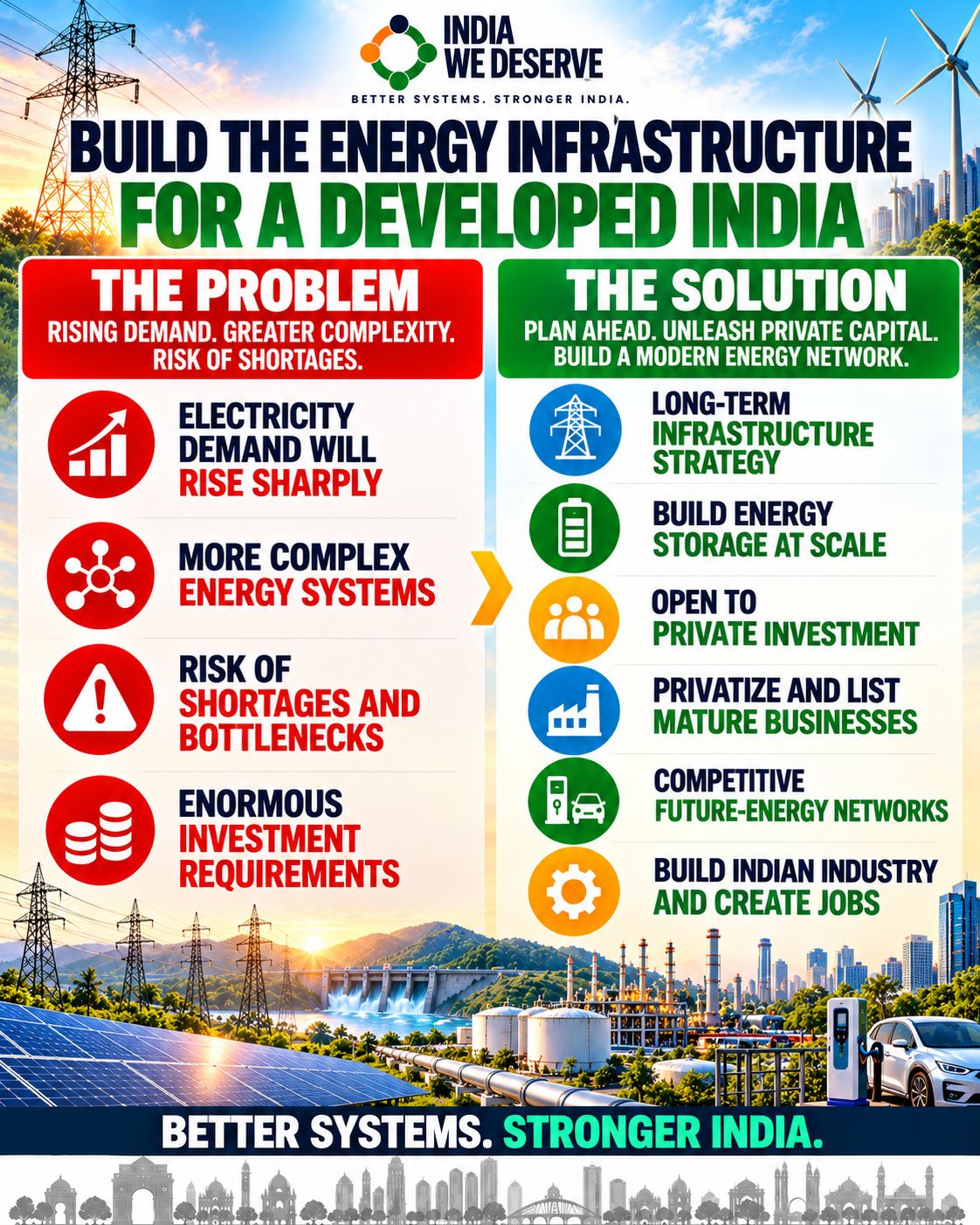
Planning for a richer, more industrialized India requires investment in the infrastructure that will power its future.
India’s energy needs will change dramatically over the coming decades. As incomes rise, industries expand, and cities grow, the country will require far more electricity than it consumes today.
Millions of households will purchase air conditioners. Electric vehicles will become more common. Manufacturing facilities will demand dependable power. Data centers, automated factories, modern agricultural systems, and expanding urban infrastructure will place increasing demands on the electricity network.
The question is not simply whether India can generate enough electricity. It is whether the country can transport, store, and deliver that energy reliably, affordably, and efficiently.
India must begin building the infrastructure for that future today, rather than waiting for demand to overwhelm existing systems.
Electricity Generation Is Only Part of the Challenge
India has made considerable progress in expanding electricity generation, particularly through renewable energy. But producing electricity is only one part of a much larger system.
Electricity must travel from generating stations to industrial facilities, commercial establishments, farms, and households. This requires transmission lines, substations, transformers, distribution networks, and increasingly sophisticated systems to manage electricity flows.
Renewable energy introduces additional challenges. Solar power is generated primarily during daylight hours, while electricity demand often continues into the evening. Wind generation varies with weather conditions. Energy storage, flexible generation, and modern grid-management systems will become increasingly important.
Electric vehicles will require charging infrastructure. Data centers will need reliable, high-capacity electricity connections. Manufacturing clusters will depend on stable power supplies that can support continuous operations.
If these investments lag behind demand, India risks creating bottlenecks that constrain industrial growth, raise costs, and discourage investment.
A country cannot become a major manufacturing power if its energy infrastructure struggles to support the industries it wants to attract.
Build Infrastructure Before Demand Arrives
Infrastructure planning must look beyond today’s consumption.
Power transmission networks, substations, storage facilities, and distribution systems often take years to plan, finance, approve, and construct. Waiting until shortages become visible means responding after the economic damage has already begun.
India should develop long-term infrastructure plans based on projected industrial development, population growth, urbanization, transportation electrification, and technological change.
These plans should identify where electricity demand is likely to grow, what infrastructure will be required, and when investments must be completed.
Industrial corridors, emerging manufacturing centers, expanding cities, and renewable energy zones should receive particular attention.
The objective should not be to build expensive infrastructure indiscriminately. It should be to anticipate demand through credible forecasts, develop infrastructure in phases, and expand capacity before constraints become serious.
Good infrastructure planning enables economic growth. Poor planning forces economic growth to wait for infrastructure.
Government Does Not Need to Finance or Own Everything
The required investment will be enormous.
India will need substantial capital for transmission networks, distribution modernization, energy storage, charging infrastructure, and digital grid-management systems.
Expecting government budgets to finance all these investments would place unnecessary pressure on public finances and compete with other priorities, including education, healthcare, and essential public services.
A better approach is to establish a clear division of responsibilities:
Government Plans and Regulates → Private Industry Builds and Operates → Capital Markets Finance Expansion
Government should establish long-term infrastructure priorities, coordinate planning, ensure fair competition, and create independent regulatory institutions that protect consumers and investors.
Private companies should have opportunities to develop, own, and operate infrastructure wherever competition or well-designed regulation can deliver reliable services at reasonable costs.
Capital markets, including banks, infrastructure funds, pension funds, insurance companies, and long-term investors, can provide financing.
Electricity networks are essential services and often natural monopolies. Private participation must therefore be accompanied by transparent tariffs, enforceable performance standards, open and fair network access, and effective independent regulation.
The objective is not privatization for its own sake. It is to mobilize capital, improve efficiency, and ensure that infrastructure expands without making taxpayers responsible for every investment.
Public funding should target areas where commercial investment cannot adequately meet essential needs, particularly in underserved and low-income areas.
Turn Infrastructure Investment Into Industrial Opportunity
Another important dimension of this opportunity.
India should not view energy infrastructure simply as equipment that must be purchased and installed. It should view the coming expansion as an opportunity to create globally competitive Indian industries.
A modern electricity network requires transformers, cables, substations, switchgear, batteries, power electronics, inverters, charging equipment, smart meters, sensors, and advanced grid-management software.
As domestic demand grows, Indian manufacturers can benefit from a large home market, develop technical expertise, improve production efficiency, and achieve greater scale.
But domestic demand alone will not guarantee international competitiveness. Indian companies will need to meet global quality standards, invest in research and development, build reliable supply chains, and compete on cost and performance.
The government can support this development through predictable infrastructure plans, competitive procurement, technical standards, workforce training, and an environment that encourages investment and innovation.
The opportunity extends beyond manufacturing. Engineering, installation, maintenance, software development, equipment testing, and infrastructure operations can create substantial demand for skilled workers.
India can build not only the infrastructure it needs, but also the industries that can supply it to other countries.
Make Reliability and Affordability Central Objectives
Expanding infrastructure should not become an exercise in spending money or announcing projects.
The real measures of success must be whether electricity becomes more reliable, whether businesses face fewer interruptions, whether energy losses decline, and whether consumers receive dependable service at reasonable prices.
Infrastructure plans should therefore include measurable targets for network reliability, project completion, transmission and distribution losses, connection times, storage availability, and investment efficiency.
Regulators should publish performance data and hold operators accountable.
Encourage competition wherever feasible, while monopoly infrastructure should operate under transparent regulatory oversight.
India must also ensure that infrastructure expansion does not impose unnecessary costs on households and businesses. Investments should be sequenced carefully, with costs and benefits evaluated before commitments are made.
The Opportunity Ahead
India’s ambition to become a prosperous, industrialized economy will require an energy system capable of supporting a much larger and more technologically advanced economy.
That system cannot be built overnight.
It requires long-term planning, predictable regulation, private investment, modern technology, and a commitment to measurable outcomes.
Done correctly, the benefits will extend well beyond reliable electricity.
India can attract manufacturing investment, boost industrial productivity, create skilled jobs, develop domestic technology companies, and build export industries that serve global markets.
The opportunity can be summarized in one sequence:
Plan Ahead → Unleash Private Capital → Build Infrastructure → Create Industries → Create Jobs → Export Technology
India should not wait for energy shortages to tell it where investment was needed.
It should build the infrastructure that allows its future economy to flourish.
That is how energy policy becomes economic development policy—and how infrastructure built for India’s needs can become an industry serving the world.
Leave a Reply