
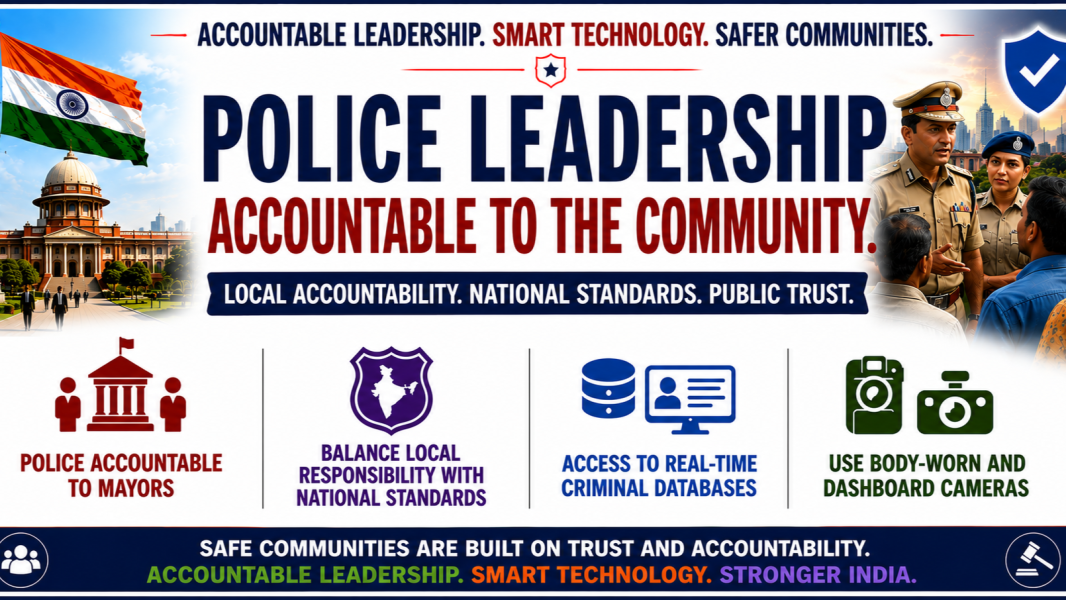
India cannot build safer communities simply by adding more police officers or buying more equipment. Lasting improvement requires something more fundamental: clear accountability, professional standards, modern technology, and policing that responds to the communities it serves.
India’s police system must combine the strength of national and state institutions with the responsiveness of local government. The question is not whether policing should be centralized or decentralized. It is how responsibility should be divided so that each level of government is accountable for what it does best.
Bring Accountability Closer to the Citizen
Police officers work in communities where crime patterns, public-safety challenges, and priorities can differ enormously. The needs of Mumbai are not the same as those of a small town in Uttar Pradesh, nor are they identical to those of a rural district.
Yet local governments often have limited authority over the policing outcomes their citizens experience.
That creates an accountability problem. When residents are unhappy with crime, response times, traffic enforcement, neighborhood safety, or police conduct, it should be clear who is responsible for improving the situation.
In cities with directly elected mayors or other accountable local executives, local government should have a meaningful role in selecting, reviewing, and holding local police leadership accountable, while safeguarding professional policing from improper political interference.
Local police leadership could then be evaluated against transparent measures such as crime trends, emergency response times, case clearance, citizen complaints, community satisfaction, and adherence to professional standards.
Accountability becomes stronger when citizens can see both who is responsible and whether results are improving.
Local Accountability Does Not Mean Abandoning State Standards
Decentralization should not create hundreds of incompatible policing systems.
States should continue to establish professional standards for recruitment, training, certification, promotion, technology, interoperability, use of force, emergency coordination, and police conduct. National institutions can establish common standards and enable information sharing across state boundaries.
The principle should be straightforward:
Set strong standards centrally. Deliver and account for policing locally.
A police officer should meet rigorous professional standards regardless of where he or she serves. But local police leadership should have enough operational flexibility to respond to the crime patterns and public-safety priorities of its own community.
Give Every Officer Better Information
Modern policing also depends on information.
An officer responding to an incident should not have to operate with fragments of information scattered across police stations, districts, and government databases.
Authorized officers should have secure, real-time access to relevant criminal records, warrants, stolen-property information, missing-person reports, vehicle information, and other lawful policing databases.
Properly designed systems could allow information to follow criminals across jurisdictional boundaries while maintaining strict controls over who can access sensitive information and why.
Technology should make policing faster and more informed without turning legitimate law enforcement into indiscriminate surveillance. Access controls, audit trails, data-retention rules, cybersecurity protections, and penalties for misuse must therefore accompany expanded digital capabilities.
Cameras Can Protect Citizens—and Honest Police Officers
Body-worn cameras and dashboard cameras should gradually become standard equipment for frontline policing.
Their purpose should not be to presume wrongdoing by police officers. Quite the opposite: reliable video evidence can protect an officer who acted properly just as readily as it can protect a citizen who was mistreated.
Recorded interactions can help resolve disputed complaints, document arrests, preserve evidence, improve officer training, discourage corruption and misconduct, and provide courts with a clearer record of events.
But cameras work only when the rules surrounding them are credible. India would need clear standards governing when cameras must be activated, how recordings are stored, who may access them, how long footage is retained, and what happens when required recordings are deliberately disabled.
Technology without accountability merely creates more equipment. Technology combined with clear rules creates trust.
Measure What Matters
Police reform should ultimately be judged by outcomes rather than announcements, budgets, or the number of new systems purchased.
Citizens should be able to see basic public-safety performance for their communities: crime trends, response times, investigation outcomes, complaints against police, disciplinary resolution, staffing levels, and other appropriate measures.
This does not mean turning policing into a race for favorable statistics. Poorly designed targets can encourage manipulation or discourage the reporting of crime. Measures should therefore be independently audited and considered together rather than relying on a single number.
The objective is simpler: make performance visible so problems can be identified and improved.
A Police System Built Around Service
Police officers perform one of the state’s most difficult responsibilities. They are asked to confront violence, protect vulnerable citizens, maintain public order, investigate crime, and make consequential decisions under pressure.
They deserve professional training, modern equipment, reliable information, clear rules, and institutions that support officers who perform their duties with integrity.
Citizens deserve something equally important: a police system that is responsive, accountable, fair, and worthy of their trust.
India does not have to choose between strong policing and accountable policing. The strongest police institutions are those in which authority, technology, professional standards, and accountability reinforce one another.
Bring responsibility closer to the communities being served. Establish strong standards across the system. Give officers modern tools. Make performance transparent.
That is how policing can become not merely more powerful, but more effective—and more trusted.
Leave a Reply