
For most citizens, the justice system does not begin in a courtroom. It begins at a police station.
And often, it begins with something as basic as trying to file a complaint.
India can modernize police forces, strengthen forensic capabilities, hire more personnel and reform criminal laws. But these reforms mean little to an ordinary citizen if accessing the system in the first place remains difficult.
Citizen access to policing is just as important as police reform.
Filing an FIR Should Be a Right, Not a Negotiation
When a cognizable crime is reported, filing an FIR should be a straightforward administrative process. It should not depend on whom the citizen knows, whether the police station is willing to register the case, or whether the complainant has the persistence and resources to keep returning.
For someone who has just experienced theft, assault, fraud, harassment or another serious offence, navigating resistance at the first point of contact adds another layer of hardship.
It also creates a deeper institutional problem.
Whenever an official can decide whether a citizen’s complaint enters the system, discretion creates opportunities for delay, influence and unequal treatment.
The law should determine whether a complaint is acted upon—not the citizen’s influence.
A Nationwide e-FIR System
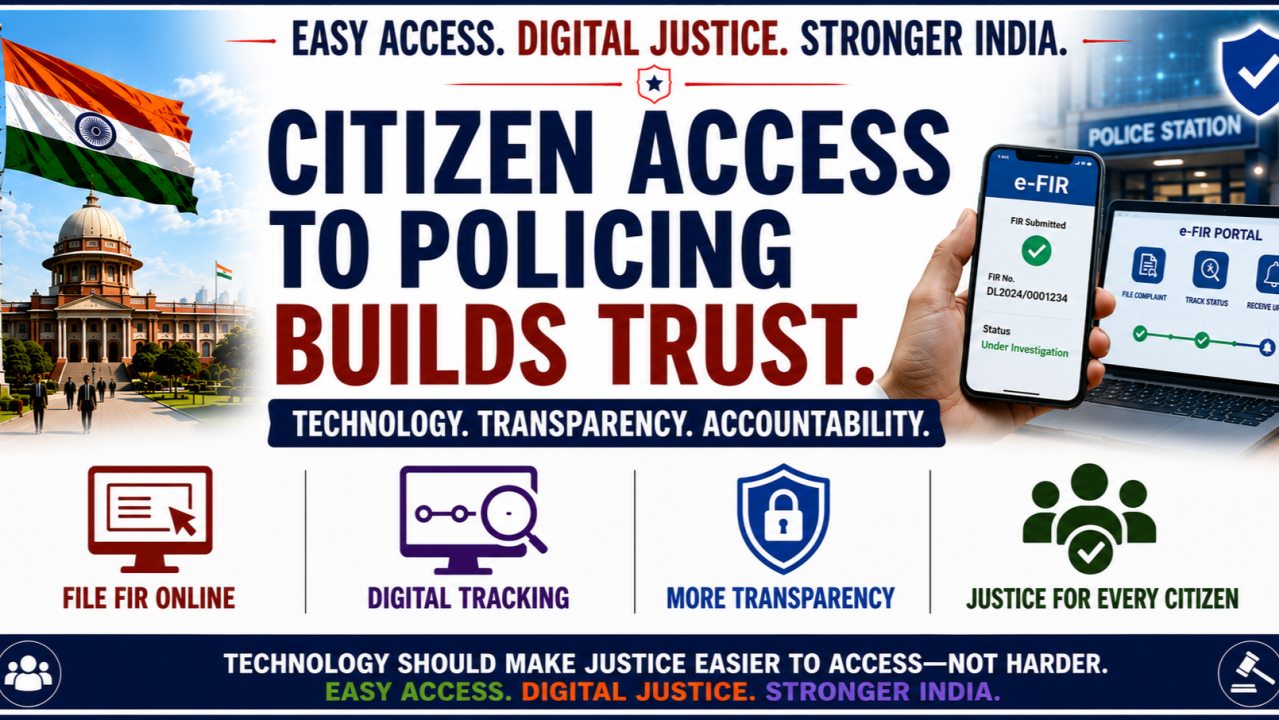
India should move toward a mandatory, standardized nationwide digital system for filing and tracking complaints and FIRs, integrated with police systems across states.
A citizen should be able to report an incident through a secure website or mobile application, upload relevant documents, photographs or other evidence, and immediately receive a digital acknowledgement and reference number.
Where the complaint meets the legal requirements for registration of an FIR, the system should route it automatically to the appropriate police jurisdiction. Where additional information or another procedure is required, the citizen should receive a clear explanation rather than being left wondering what happened.
Physical police stations must, of course, remain available. Digital access should expand citizens’ choices, not replace in-person access, particularly for people who lack internet access or need immediate police assistance.
From Filing to Tracking
Digitizing the initial complaint is only half the reform.
Citizens should also be able to see what happens afterward.
A secure tracking system could provide appropriate updates such as:
Complaint received → FIR registered → Investigating officer assigned → Investigation underway → Chargesheet/final report filed
Not every investigative detail can or should be disclosed. Protecting victims, witnesses, evidence and the integrity of an investigation must remain paramount.
But basic procedural transparency should be the norm.
If a complaint is transferred, closed or determined not to warrant FIR registration, the system should record the decision, the responsible authority and the reason, subject to the requirements of law.
This creates something that paper-based and discretionary processes often lack: an auditable trail.
Technology Can Reduce Discretion
The greatest benefit of an e-FIR system is not convenience alone. It is accountability.
A properly designed digital system could automatically record when a complaint was received, when action was required, when responsibility was assigned and how long each stage took.
Police leadership could identify stations with unusual delays or patterns of non-registration. State governments could measure performance across districts. Independent oversight bodies could analyze systemic problems. Citizens would have evidence of when they approached the authorities.
Instead of relying primarily on anecdotes, policymakers could begin asking measurable questions:
How long does registration take? Where are complaints being delayed? Which categories of crime experience the greatest bottlenecks? How quickly are investigations progressing?
What gets recorded can be measured. What gets measured can be held accountable.
Technology Alone Is Not Reform
A digital portal cannot solve every weakness in policing.
If complaints submitted online can simply disappear into another bureaucratic queue, digitization merely converts a paper problem into a digital one.
The system therefore needs clear service standards, escalation mechanisms and accountability.
Citizens should know where to appeal when required action is not taken. Supervisory officers should automatically be alerted when prescribed timelines are exceeded. Performance data should help identify persistent institutional failures.
The system must also be designed carefully to prevent misuse, protect personal information, maintain cybersecurity and safeguard sensitive information involving victims and witnesses.
Technology should support good institutions—not substitute for them.
Justice Begins With Access
For decades, discussions about justice reform in India have understandably concentrated on police capacity, judicial delays, vacancies, court infrastructure and punishment.
But there is an earlier question:
Can an ordinary citizen enter the justice system easily, without influence or negotiation?
A nationwide digital complaint and e-FIR framework, combined with tracking, defined timelines and accountability, could make that first encounter with the justice system simpler and more transparent.
The principle is straightforward.
A citizen should not need connections to have a complaint recorded. A citizen should not have to repeatedly ask what happened to it. And government should be able to measure whether the system responded.
Technology has transformed how Indians bank, pay taxes, transfer money and access government services.
It should now help make something even more fundamental easier to access:
Justice.
Leave a Reply