
For most citizens, the police are the most visible face of the justice system.
When someone faces theft, violence, harassment, fraud, a road accident, or another emergency, the first call is rarely to a court or a government ministry. It is to the police.
Yet we often expect police officers to provide faster responses, investigate crimes thoroughly, maintain public order and protect communities without asking a fundamental question:
Do we have enough police officers to do the job well?
India’s Police Force Is Stretched Too Thin
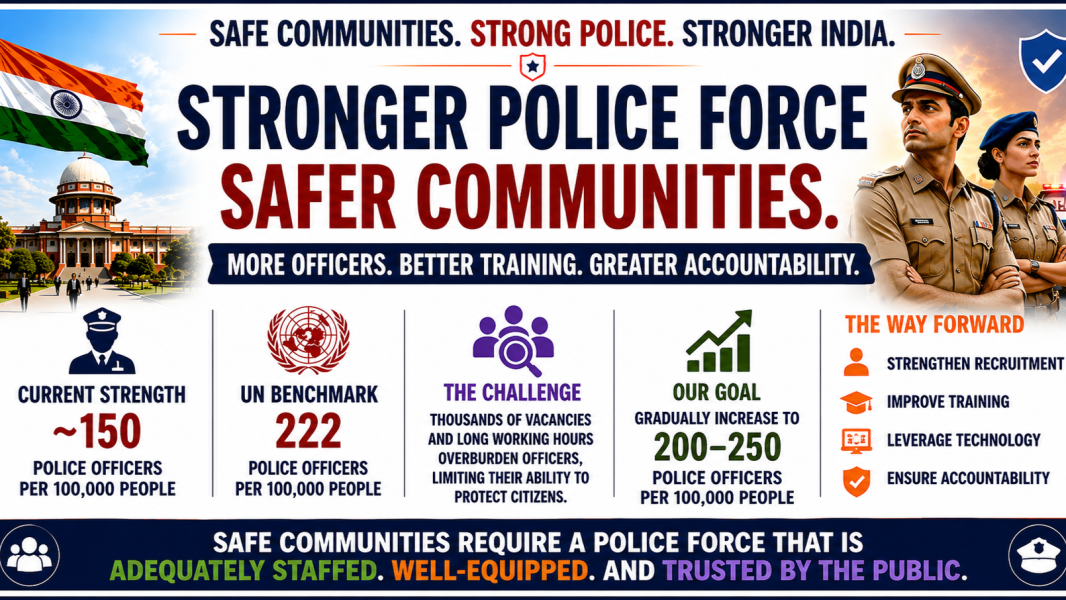
India has only about 150 police officers per 100,000 people, well below the often-cited benchmark of 222.
Behind this number lies another problem: thousands of sanctioned police positions remain vacant.
The consequences eventually reach both police officers and citizens.
When police stations operate with inadequate staffing, officers must handle more cases, work longer hours, and perform multiple responsibilities simultaneously. Investigation competes with patrol duties. Administrative work competes with community policing. Emergencies inevitably take priority over preventive work.
An overburdened police force cannot consistently provide the quality of policing citizens should expect.
More Police Officers—But Not Just More Police Officers
India should gradually work toward a police strength of approximately 200–250 officers per 100,000 people, based on the policing requirements of different states and communities.
But simply adding personnel will not solve the problem.
Expansion should be accompanied by improvements in recruitment, training, specialization, technology, working conditions, and accountability.
New officers need professional training not only in criminal law and investigation, but also in areas such as cybercrime, financial crime, forensics, domestic violence, community policing and the appropriate use of technology.
Police forces also need specialists. Modern crime increasingly involves digital evidence, financial transactions, sophisticated communications and crimes that cross traditional geographic boundaries.
The police force of the future cannot operate exactly like the police force of the past.
Technology Should Multiply Police Capacity
Increasing staffing should go hand in hand with reducing unnecessary administrative work.
Digitized records, e-FIR systems, integrated case management, automated traffic enforcement, digital evidence systems, and improved data analytics can enable officers to spend more time on policing and less time on moving paperwork through the system.
Technology can also strengthen accountability.
Digital records can establish when a complaint was received, when an officer was assigned, what action was taken, and how long each stage took. Supervisors can identify delays and unusual patterns much earlier.
More police capacity and greater police accountability should advance together.
Better Working Conditions Matter
Police reform must also recognize the people wearing the uniform.
Long and unpredictable working hours, inadequate staffing and constant pressure eventually affect judgment, morale and interactions with citizens.
A professional police force should have reasonable working conditions, adequate rest, appropriate equipment, continuing training, and access to mental health and welfare support.
We cannot demand consistently professional policing while accepting working conditions that make professionalism increasingly difficult.
Strength Must Be Accompanied by Trust
A larger police force without accountability can create different problems.
That is why police expansion should be accompanied by clear operating procedures, transparent complaint mechanisms, independent oversight where appropriate, measurable service standards and consequences for misconduct.
Citizens should be able to expect the same treatment regardless of their wealth, status, connections, caste, religion, gender or political influence.
The objective is not simply a stronger police force.
It is a more capable, professional and trusted police force.
Safer Communities Require Capacity
India’s population, cities, economy and technological complexity have grown enormously. The institutions responsible for protecting citizens must evolve with them.
Increasing police strength toward 200–250 officers per 100,000 people will require sustained investment over many years. Recruitment will need to be accompanied by training, infrastructure, technology and institutional reform.
But public safety is one of the fundamental responsibilities of government.
A country cannot expect safer streets, faster investigations and better enforcement indefinitely from an overstretched system.
Safe communities require enough police officers to protect them, enough resources for those officers to do their jobs well, and enough accountability for citizens to trust them.
A stronger India requires a police force that is adequately staffed, professionally trained, technologically equipped—and trusted by the people it serves.
Leave a Reply