
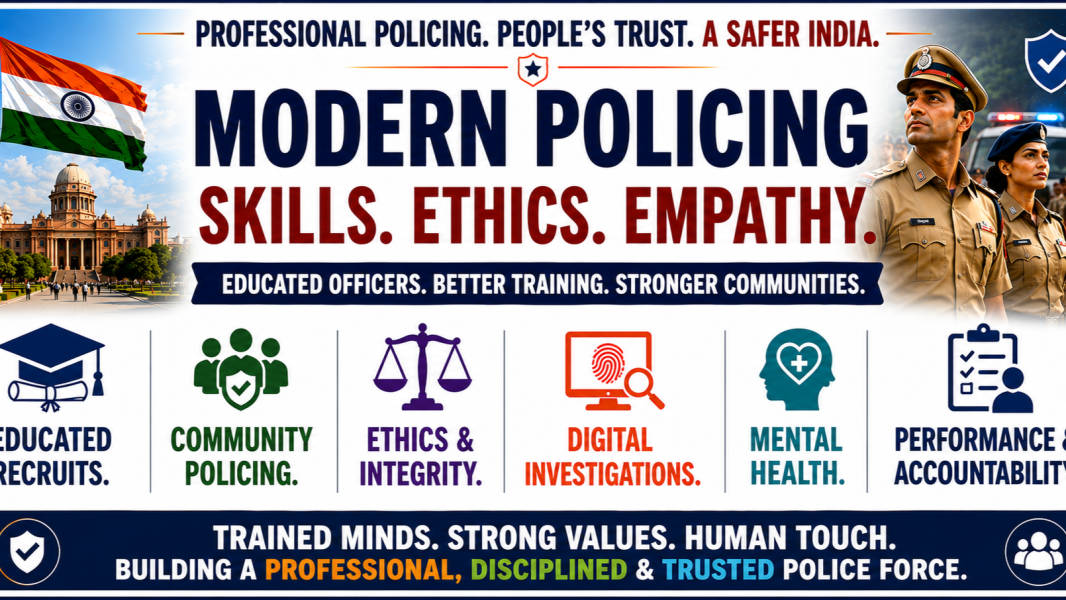
Modern policing requires far more than physical strength and the ability to enforce the law.
A police officer today may be called upon to investigate cybercrime, respond to domestic violence, manage public protests, deal with a person experiencing a mental health crisis, preserve digital evidence, resolve community disputes, and make decisions involving citizens’ constitutional rights and personal liberties.
These are complex responsibilities. They require judgment, education, restraint, communication, integrity, and professional training.
If we expect policing to meet the demands of a modern India, we must also modernize how police officers are recruited, trained, supported, and evaluated.
Raise the Educational Standard
Police officers exercise some of the most significant powers entrusted to the state. They can detain citizens, investigate them, restrict their liberty, use force, and initiate actions that may ultimately lead to criminal prosecution.
Such authority should be accompanied by high professional standards.
India should progressively move toward requiring police recruits to hold at least a bachelor’s degree, followed by rigorous professional police training.
A degree by itself will not make someone a good police officer. Character, judgment, courage, and integrity remain essential. But higher educational standards can provide a stronger foundation for analytical thinking, communication, understanding institutions, interpreting evidence, and dealing with increasingly sophisticated forms of crime.
Policing should increasingly be regarded as a profession requiring both education and specialized training.
Modernize Police Training
The nature of crime has changed dramatically.
Financial fraud can cross several states in seconds. Criminal activity increasingly involves mobile phones, digital payments, social media, encrypted communications, online platforms, and sophisticated financial networks.
Police training must evolve accordingly.
Recruits should receive substantial instruction in community policing, constitutional rights, professional ethics, cybercrime, digital investigations, financial crime, mental-health intervention, domestic violence, crimes against women and children, evidence preservation, conflict de-escalation, and modern investigative techniques.
Training should not end when an officer leaves the police academy. Laws change. Technology changes. Crime changes. Professional policing requires continuous education throughout an officer’s career.
Support the Mental Health of Police Officers
Police officers routinely encounter situations most citizens rarely experience: violent crime, serious accidents, death, family conflict, public disorder, long working hours, and sustained pressure.
That exposure carries a psychological cost.
We cannot expect officers to exercise calm judgment in difficult situations while ignoring their own mental well-being.
Regular psychological screening, confidential counseling, stress-management programs, reasonable working conditions, and early intervention should become normal parts of professional policing.
Supporting the mental health of police officers is not only about protecting officers. It can also improve decision-making, reduce inappropriate behavior, and protect the citizens with whom they interact.
Build a Culture of Performance and Accountability
Professional institutions require meaningful performance standards.
Police officers should be evaluated periodically on the quality of their investigations, knowledge of the law, conduct toward citizens, disciplinary record, ability to resolve situations appropriately, leadership, integrity, and overall professional performance.
Career advancement should increasingly reward competence and performance rather than simply seniority or connections.
Good officers should know that professionalism and integrity will help them advance. Officers who repeatedly demonstrate poor performance or misconduct should face appropriate consequences.
Accountability should not weaken the police. Done properly, it strengthens the institution and increases public confidence in those who serve within it.
Give Police Officers the Tools to Succeed
Reform cannot consist only of demanding more from police officers.
India must also provide them with the tools needed to meet those expectations.
That means better training, modern technology, adequate staffing, professional working conditions, mental-health support, merit-based career progression, and greater insulation from inappropriate political interference.
Police officers who perform difficult jobs with integrity deserve professional respect and institutional support.
Higher expectations and better support must therefore advance together.
Build a Police Force Citizens Can Trust
The purpose of police reform should not simply be to create a more powerful police force.
It should be to create a more capable, educated, disciplined, ethical, accountable, and trusted one.
Citizens should be able to approach a police officer with confidence. Police officers should be able to perform their duties professionally without improper pressure. And both should operate within a system where the rules are clear and apply consistently.
In a modern democracy, the strength of policing is not measured by how much authority an officer possesses.
It is measured by how professionally, fairly, and responsibly that authority is exercised.
Better policing requires better systems. And better systems build a stronger India.
Leave a Reply